| |
|

Libyan
Constitutional Union
http://www.libyanconstitutionalunion.net
&
http://www.lcu-libya.co.uk
|
|
|
|
|
|
بسم الله الرحمن
الرحيم
The Libyan Constitutional Union:
Its Establishment and Development
A Documentary Article
by Mohamed Ben Ghalbon
(Summary Translation from Arabic)
| |
Readers of this series of documentary articles will be able
to examine a narrative of historical events that took place in
an important period in the history of our country. I am of
the opinion that it is a duty to the homeland to record and
publish these historical events, so that we do not lose
contact with that important part of our contemporary history.
As the narrative of these events deals with the stances of
some individuals who were active participants in them, it
becomes essential that these stances be recorded in their
proper contexts. The intention behind the publication of
these accounts, almost a quarter of a century after their
occurrences, is not to criticise or denigrate the individuals
who were active participants in them. Rather, this publication
is a modest attempt to uncover and clarify part of our history
that has passed over in silence. Thus, I hope that this aim
should not be misconstrued and the writer of this article
should not bear the responsibility for the cynical
interpretations by others of its content. |
|
Part (1)
(First published in Arabic on
11th June 2006)
Quest to obtain King Idris’s consent
Preamble
The
idea of writing this documentary article was dictated by Mr Faraj
El-Fakhri’s enquiry in his article “The Squandered
Opportunities” in which he asked:
“Why did the LCU not
succeed in attracting The Libyan opposition groups around its
slogans during that early period [1981]? These are the same slogans
adopted and raised today by Libyan opposition movements. Chief
among these slogans was the call raised by the LCU at its inception
to rally around
King Idris I,
who was still alive then. This in reality was a call to rally
around the symbol of constitutional legitimacy of Libya
[1]
Mr
El-Fakhri
continued his article by expressing the hope that the LCU founder
members would undertake the task of explaining all the circumstances
that led to the squandering of the
opportunity that the
LCU provided the Libyan opposition with, in asking them to unite in
support of the Libyan Constitution. This demand which was
ignored 25 years ago has now become a key demand of the Libyan
opposition
[2].
Mr El-Fakhri
further expands his narrative with the enquiry as to why the LCU was
not successful in realising its goals (mentioned above), and
followed that by asking another question of two parts:
o
“Was this failure due to the incompetence and the inability of
the leadership of the LCU, at that time, to explain and communicate
their idea to the others?
o
Or does the shortcoming arise as a result of the conflict of
concepts and ideas among the competing opposition movements?”
He concludes by asking
the founders of the Libyan Constitutional Union to provide answers
and explanations to an era full of events, facts and secrets which
in their totality are the reason behind “squandering that
opportunity”
[3].
Previously, I had
always had the intention and the resolve to talk about this
important era in the history of our homeland; however my fear for
the hurt that this might cause to the people who participated in its
events, due to their dishonourable stance, has prevented me so far
from doing so. I constantly delayed talking about this era and
waited for the time when the circumstances are right, more
accommodating and accepting for such an action. I consider the
current circumstances may be more suitable to deal with these
important events in our homeland’s recent history.
When I resolved to have
a written record about these important and thorny events I thought
it sensible to suggest to Mr Farag Elfakhri, whose
questioning gave rise to writing about these events, that he puts
together this record in a suitable writing style.
I immediately
telephoned Mr El-Fakhri and suggested we meet to answer his
line of questioning, and asked if it was possible for him to write
and edit the answers then to send them to me to review for
publication on the Libyan web sites. Mr El-Fakhri’s response
to undertaking this difficult task was agreeable and welcoming. We
agreed to meet in Leeds to start the narration of the information of
this period to him while recording it on cassette tapes. Our
meetings started in October 2005 (Ramadan 1426) in the presence of
my brother Hisham. The narration took six separate meetings.
Furthermore, the
narrative will be in the first person pronoun in the same fashion it
was received by the editor.
**
***
**
The
beginning
When I decided, in the
early 1980’s, to convert the idea of establishing the Libyan
Constitutional Union, which was ripe in my mind for some time,
into a reality it was imperative that I get in touch with the late
King Idris (may Allah bestow His mercy on his soul) who
embodied the Constitutional legitimacy to rule Libya. He was
usurped of that rule by a group of low ranking officers who staged a
coup d’etat in September 1969.
It was important that
this should be the first step, as the issue of the Constitutional
legitimacy to rule is part of the foundation and one of the
principles upon which the idea of establishing the Libyan
Constitutional Union was based.
So I embarked on
attempting to gain access to King Idris. That was not an easy
task. It was an ordeal with many obstacles that I had to overcome.
The late King had been
living in Cairo as a political refugee since the staging of the
military coup in Libya, in a villa in the suburb of Dokki in Cairo,
which was assigned to him by the Egyptian Office of the President.
He was forbidden by the Egyptian authorities to deal with political
affairs or to receive any person active politically against the
military government in Libya. A team of Egyptian security
personnel, headed by a veteran officer was appointed to serve,
protect and keep a continuous watch over the king.
It was very difficult
to pass through the security cordon imposed on the King’s residence
and to reach him through the normal means. The very close watch over
the King’s person and his movements isolated him from the outside
world except for few relatives or old close friends.
Therefore, there was
no way for me to get in touch with the King except through one of
these few persons who used to visit him and his estimable family.
**
***
**
Contacting the King:
After getting in touch
with many in the circle of my personal connections and looking
carefully and persistently for information from every source, I
managed to
approach an
honest and dependable person from among the few who had direct
contact with the King. I asked this person to convey a message from
me to the King. I stated in this message my wish to visit His
Majesty to talk to him about my resolve to found The
Libyan Constitutional Union, and to renew -on behalf of my self,
my family and collegues- our pledge of allegiance to His Majesty as
the constitutionally legitimate ruler of
Libya. And to proceed
thereafter -with his permission-
towards urging Libyan
notables from various regions of the country to do the same in
public – by publicising it in the international media.
It is important to
emphasise that
the pledge of allegiance here does not imply that
the Libyan people’s pledge of allegiance
to the King before Independence had withered or that it had lost its
legitimacy, on the contrary, The King’s constitutional legitimacy
was rooted in the unanimous desire of the entire nation for him to
be their King and this constitutional legitimacy could not be
revoked by an illegitimate act.
Renewal of the pledge
of allegiance means the affirmation of the continuity of the old
pledge of allegiance, and proof that it has not lost its holding
force, for the new pledge of allegiance – in its essence- is
considered a symbolic pledge of allegiance re-affirming the old one,
and referring to its genuine legitimacy. Proving that the pledge of
allegiance to the King and calling on him to resume his role as
ruler of the country is a legitimate and constant right that time
has not erased, nor revoked by the usurping of authority by force.
And so this
praiseworthy person continued to convey my successive oral messages
to the late King. This had lasted for many months approaching a
whole year. I was careful in these messages to King Idris to
affirm my hope that he might not deprive his people of his blessing
and the bestowing of his legitimacy on our call upon him to be the
legitimate ruler of the country.
In all my messages to
King Idris, I was appreciatively and considerately aware of
his ascetic way of life, his reluctance to rule or hold power and
his loath to return to office and resume its burdensome duties.
However, there was an overwhelming necessity imposing itself
on this case and making his approval inescapable This necessity
went beyond the personal desires latent in this pious and devout
King, and would not accept from him –or anybody in his station-
compliance with his own personal preferences. This necessity
dictated that the late King consent to providing, the sacred task of
liberating the home land, with his blessings.
If it had not been for
the above mentioned necessity, I would not have dared to
approach the devout and pious king on the subject concerning the
legitimate right to rule the country
There was therefore a
heavy price for King Idris to pay, as he had no interest to
rule at his advanced age and he wished to spend the rest of his life
in worship and meditation.
Therefore, I took care
in my oral messages to King Idris to emphasize that his
consent to give this noble task his blessings was imperative to open
the way to liberate Libya. Thus providing this endeavour with legal
and legitimate support which the world would pay attention to. And
on the other hand this approval would create the leadership and
symbol which the Libyan Opposition was in dire need of.
In my successive
messages, I affirmed to the late King my full consideration to his
weak health and old age. Further, at that time I thought that, and
in keeping with my belief that only Allah knows when one dies, The
Creator might not give him the time to witness the
struggle for the liberation to its end.
However, it was of the utmost importance to obtain his blessings
for the call upon him to be the legitimate ruler of the country, for
he would provide, by giving his consent, blessings and an honourable
seal to the struggle to regain the freedom of the country with its
necessary means and materials. And even if Allah willed that he
would die before the end of this struggle, then the struggle would
definitely continue with the authority derived from his
constitutional legitimacy.
I made sure that my
oral messages were detailed enough to cover all aspects of this
matter which would neither strain the King nor burden him with too
much responsibility. Further, it would not breach his undertaking to
the Egyptian authorities concerning his non-involvement in politics.
On the spiritual
front, I was adamant that he not leave this world before remedying
the hurt and injury he was feeling as a result of his people’s
failure to defend him when he was affronted by the dregs of
society. I was seeking his forgiveness of the Libyan people in the
hope that through it they would find a way out of their ordeal.
So at this stage it
only remained to meet His Majesty, and this meeting would implicitly
mean his approval of the content of my messages. This was the
beginning of another arduous journey, for as I have explained
before, his meeting was very difficult to arrange. For there were
not only the Egyptian security apparatuses watching the King 24
hours a day but also “Haj Mohammad El-saifat” who, as a result of
his old relationship with the King, gave himself the right to decide
who should visit the King and who should not.
To be continued….
Mohamed Ben Ghalbon
chairman@libyanconstitutionalunion.net
8th July
2006
[1]
Part two of “The Squandered Opportunities”, posted on “Libya Our
Home” on 23rd September 2005.
http://www.libya-watanona.com/adab/ffakhri/ff23095a.htm
[2]
Ibid
[3]
Ibid |
|
|
|
Top of
the Page
Original Arabic |
|
|
|
|
|
|
|
|
This part was published on the
following Libyan sites |
|
"Libya
Our Home" ,
Libya Al-Mostakbal"
, "Al-Manara"
|
|
|
|
 |
|

|
|
|
|
بسم
الله الرحمن الرحيم
Part
(2)
(First
published in Arabic on
14th June
2006)
Quest to obtain King Idris’s consent
Paving the way for a meeting with The
King:
As
I have previously explained, having passed to the King my messages
regarding my intention to establish the LCU, all that was remaining
was to meet His Majesty to renew the allegiance and then announce
the establishment of the Libyan Constitutional Union. I have also
mentioned in part 1 that meeting the King was neither an easy matter
nor an easily attainable goal, for to meet him, one had to overcome
several difficulties, namely getting through the vigilant Egyptian
security, or gaining the acceptance and the consent of Haj El-Saifaat,
who gave himself the authority - by virtue of the old relationship
that he had with the King- to vet the individuals who would like to
visit the King and would decide who could see him and who could not.
Fortunately, I did not
have to go through either of these two channels. The visit was
arranged, with the king’s permission, by the person who acted as the
link between the King and I. Furthermore, this visit would not be
an occasion where I repeated what had already been communicated to
the King through this intermediary. The meeting would finalize the
aspects contained in my messages to him, for me to pledge my
allegiance and for him to give his blessing to the establishment of
the Libyan Constitutional Union.
The intermediary and I
agreed to meet in Egypt during the month of August (1981). We
agreed that I would wait for this person (the intermediary) to
telephone me at my father’s house in Alexandria. I had travelled
from Manchester to Alexandria during the agreed upon period but
after sometime there I was not contacted as previously agreed.
Due to my good
knowledge of the extent of honesty, nobleness, generosity and good
intentions of this individual, I was sure a situation must have
presented itself that prevented the contact
I found myself in a
dilemma; I was not in favour of resorting to either of the two
channels mentioned previously in this regard, due to the sensitive
nature of my visit to The King, which made it unwise to reveal it to
anybody yet. However, I was forced to contact Haj Mohamed El-Saifaat
who knew the intermediary, and asked him to pass my phone number to
our mutual friend to contact me urgently in Alexandria, for I had
been entrusted to deliver something to that person prior to my
return to the UK. I made this excuse to Hajj El-Saifaat to avoid
telling him about my previous and next contact with King Idris.
Shortly afterwards the
intermediary contacted me and apologised profusely for not getting
in touch with me in the specified period due to losing my telephone
number, and that all attempts to get my number from others had
failed. The intermediary informed
me at once that an appointment had been arranged for me
to visit the King to finalise the noble
aim I dedicated my self and my team to accomplishing.
On the specified day
of this visit, the intermediary arranged a meeting for me with Mr
Omar Shelhi, who I was informed, had volunteered for the task of
accompanying me, hence
facilitating my entry to the King’s residence
through
the Egyptian security apparatuses.
That would be the first time I ever met Mr. Omar Shelhi.
**
***
**
In the presence of the King:
I met
Mr. Shelhi on the specified date at a predetermined location. From
there we went in his car to the King’s residence in the suburb of
Dokki.
As soon
as the car stopped in front of the villa we entered through a gate
that was surrounded by Egyptian security men who greeted and
welcomed Mr. Shelhi, whom they knew very well and therefore neither
stopped him, nor checked the identity of the person who accompanied
him.
As we
entered the sitting room, my companion introduced me to King Idris
and Queen Fatima whose warm and
affectionate welcome
made me feel very happy and at ease.
I addressed the King
and expressed my feelings of deep sorrow and regret for the
suffering and pain he had to endure in his exile away from his
homeland and people for whom he spent his entire life to achieve
their independence. I dissociated my self from what the dregs of
society had inflicted on him, and made clear to him my profound
awareness of his grand spiritual rank. I then expressed my renewal
of allegiance to him as the King of Libya.
I told him I would
like to know his verdict concerning what he had examined regarding
the matter of the establishment of the Libyan Constitutional Union
and the call upon him to be the legitimate ruler of the country.
The reply of the pious King was brief but eloquent and decisive. He
looked at me and quoted from verse 3 of Surat Al-Fath:
“May Allah make
your victory an impregnable victory”
"
ينصُرَك الله نصراً عزيزاً
I kissed the King’s
hand and departed, totally overwhelmed with happiness and joy, I
felt my feet could hardly touch the ground. My arduous efforts to
obtain his consent and blessing to continue in this patriotic and
task were crowned with success.
Mr Omar Shelhi
accompanied me to the outside gate of the villa and as we got into
the car he asked me about my destination. When I replied he said
that the distance was short and he suggested that we could walk it
together.
I understood at once
that he wanted to talk to me about the subject matter that I came to
see the King for, and walking together would provide him with the
longer time needed for that purpose.
As I expected, as soon
as we got out of the car and started walking my companion asked me
if I was aware of the enormity and the gravity of the undertaking
for which I had endeavoured to obtain the King’s approval. He
continued with answering his own question and added that; if I was
not aware, I was attempting to cross a minefield.
I told him that I was
quite aware of what he meant and that I understood perfectly the
nature and magnitude of the task I was about to undertake. And I
ask Allah’s help in order to succeed to do our country, which was
suffering under the hated military regime, a lot of good. He then
said to me that this task would not only require me to defend the
monarchy as embodied in the person of the King, but also to defend
the entire regime of the monarchy i.e. its personalities and
symbols, especially those who were very close to him and considered
his clique.
It was
clear from his previous hint that he was aiming to entice me to
adopt the stance of defending him and his family when defending the
King; however, I was clear, frank and decisive in this regard.
I further explained
that I did not consider it to be the most suitable of times to raise
the banner of monarchy in Libya. The coup d’etat regime had
successfully, worked relentlessly with all the state resources at
its disposal to distort the image of such a form of government, and
to level all sorts of false accusations against it. Furthermore, I
told him that he had to bear in mind that the prevalent trend among
the Libyan intelligentsia and the opposition ranged from the
so-called “progressive ideas” in the leftist and liberal tendencies
to the growing religious currents. All of the people of all these
persuasions, at least at that time, did not wish to be associated
with the Monarchy in Libya.
On the other hand,
when I advanced the idea of establishing the Libyan Constitutional
Union and thought about the necessity of obtaining the blessing of
the King for it, because of his constitutional legitimacy as
documented in the codification of a constitution agreed upon by all
of the Libyan nation, I did not envisage that I would be in the
position of defending personalities that had political and titular
offices and positions in the monarchy regime. It was not my
intention to justify or catalogue the mistakes of some of the
symbols of the monarchy regime, for this was not my business and
these personalities could defend themselves if they wanted to. My
task in this regard would be limited to the King and the
Constitution, and may Allah help me in the onerous and difficult
crossing of the minefield and I was certain of the difficulty
involved in doing so.
My
answer above put an end to Mr. Shelhi’s hope of enlisting me to
defend him and his family and consequently ignited his enmity
towards me.
Our
conversation ended at that point, as we reached my temporary
accommodation.
I
thanked Mr Shelhi for his generosity in facilitating my meeting with
the King and he said good-bye to me in a cool manner which he made
no effort to disguise.
To be continued…
Mohamed
Ben Ghalbon
chairman@libyanconstitutionalunion.net
21st
July 2006
|
|
Top of
the Page
Original Arabic
|
|
|
|
|
|
|
|
|
This part was published on the
following Libyan sites |
|
"Libya
Our Home" ,
Libya Al-Mostakbal" , "Al-Manara"
|
|
|
|
|
|
|
|
بسم
الله الرحمن الرحيم
Part (3)
(First published in Arabic on
1st July 2006)
[2] Announcing the Establishment of the
Libyan Constitutional Union
Introduction…..
It is
important that readers know that during all of my contacts with the
leading personalities of the various Libyan opposition movement, in
exile to publicise the establishment of The Libyan Constitutional
Union and to acquaint them with it,
that at no time did I ever criticise nor attack any of these
individuals. Even when some directed their attacks to me personally,
and spread doubts and suspicion over the reasons, goals and motives
of my clear campaign.
I
restrained my self, from getting engaged in exchanges (verbal or
written), with those who did not follow the etiquette of
constructive criticism and went along a path of hostility and
arrogance that drove them to consider me as their enemy which I was
not. I approached them in the spirit of peace and affability for
the purpose of unifying the ranks under one umbrella forming an
entity that was capable of realising the aim of helping our country
and saving it from the corrupt regime.
Even when
I was forced to take a stand against those who overstepped the
boundary of professional courtesy in their personal attacks against
me and my family, I always confined my responses within decency,
good manners and to the point.
As
I have repeatedly said, my purpose of writing this article is to
record and document important events and stances in our contemporary
history, however, at the same time I affirm that I have been very
careful to write this article and publish it when most of the
people, who participated in these events, are still alive.
This
insures accuracy and truth in recording and documenting the
information. It also requires me to give ample opportunity to those
concerned to respond to the information presented in this article
with respect to their referred stances and allows them to affirm,
refute or add to them.
In
return, I hope that those people who desire to reply or comment on
this article, be bound by the principles of moral responsibility in
their stating of the mere facts without fabrication or distortion.
I
also hope that these people have the moral courage to write under
their real names and not to resort to hiding behind
pseudonyms
making it on the one hand hard to hold them accountable for the
falsehoods they propagate and on the other hand this use of
pseudonyms impairs the chance for everybody to enrich serious and
responsible discussions and dialogues about important events in our
country’s recent history.
*
*
*
*
*
Announcement of the Establishment of the LCU:
The
publicity campaign for the establishment of the Libyan
Constitutional Union started with a greeting card on the auspicious
occasion of the Greater Bairam (Eid Aladha) as it coincided with 7th
October (1981), the thirtieth anniversary of the proclamation of the
Libyan Constitution. It contained the statement announcing the
establishment of the L C U[1],
its motives and aims. It was widely
distributed among the Libyan citizens inside and outside
Libya. The number of these letters reached thousands, for we managed
to obtain lists of names and addresses of a large number of Libyans
residing in Egypt whose numbers then could be counted in thousands.
We
also obtained lists of names and addresses of large numbers of
Libyan students in the United Kingdom and in the United States of
America
[2].
Furthermore, we sent thousands of letters containing the relevant
information to the mail boxes in various Libyan Cities addressed to
fictitious names. These would reach the owners of the mail boxes
without jeopardising the safety of the mail box owners, who could
easily dissociate themselves from these letters, should the
oppressive authorities discover them, as those letters were
addressed to unknown names unconnected to them.
It came to our knowledge through some people from inside the country
that the mailing of these letters had achieved the desired success
to a large extent.
*
*
*
*
*
This was
on the general level, we also endeavoured to contact directly all
the active Libyan opposition groups (some of their members were
already known to us personally), as well as many Libyan notables to
inform them about the newly established Libyan Constitutional Union
through letters containing a thorough explanation of the principles
and aims upon which the Libyan Constitutional Union was established.
We also
made personal contacts through telephone calls, mail and meetings
with the personalities that we had known previously, to inform them
about the matter under consideration and to explain to them fully
the essential nature of the Libyan Constitutional Union and its
planned aims. This was aided by issuing three carefully prepared
booklets, which were sent to the relevant parties in three
instalments in the period between 7 October 1981 and the end of
December 1981.
[3]
In tandem with sending these letters and booklets, there was media
coverage regarding the establishment of the Libyan Constitutional
Union as soon as it was announced.
*
*
*
*
*
Reactions…….
Contrary
to our expectations not many among the dozens of individuals whom we
had contacted personally to inform them about the establishment of
the Libyan Constitutional Union, bothered to respond or to reply.
However, the reactions of those who showed a degree of interest were
diverse.
The
replies were divided according to the level of intellect and
background of the individual concerned. Some of these people who
replied had a high level of moral sensitivity and a sense of
patriotic responsibility, in addition to a degree of intelligence
and heedfulness in grasping the concept advanced by the Libyan
Constitutional Union and the ability to see its ramification on the
future of the national cause.
At
the same time, other reactions had elements of chauvinism and the
preference of personal and political interests at the expense of the
national cause.
Others still, were motivated and driven by tribalism without any
consideration to the interests of the homeland and its essential
causes.
In what follows, I will talk about the various reactions which were
typified by some opposition personalities in exile. These
personalities were contacted and met by the Libyan Constitutional
Union in the period of its establishment and after that.
This
was for the purpose of the unification of all the Libyan opposition
under one umbrella with a program containing the assertion of the
legal legitimacy which would facilitate the struggle against the
ruling military regime through international legal legitimacy and
accord the Libyan cause through effective means capable of toppling
the corrupt regime.
*
*
*
*
*
Omar El-Shelhi
As I
mentioned previously in part 2, my relationship with Mr. Omar El-Shelhi
had grown cold and uneasy. However, our subsequent frequent
meetings at the King’s residence during my regular visits to the
King which I endeavoured to maintain throughout his life, had a
positive effect on this relationship and softened Mr. Shelhi’s
unfriendliness towards me. For, with time and as he followed the
LCU’s publications, and knew me more through these visits, he became
more convinced of my true intentions, and satisfied himself that I
was not an adventurer who would abuse the king’s reputation or an
intruder with an ill agenda. He saw that my coming close to the
King was motivated by loyalty and pure love of the King, coupled
with a genuine desire to benefit the national interest.
With
time, some sort of familiarity had formed between Omar El-Shelhi and
my self, which before long developed to a strong friendship. We
exchanged visits and frequent phone calls. However, this friendship
did not go beyond personal amity, and never involved any sort of
political alliance or co-operation.
During
this closeness to Mr. El-Shelhi, I discovered two
distinctive marks of
his
character. The first was that he has a deep and unrivalled sense of
patriotism towards the home land. The second and more vivid was his
unlimited loyalty and devotion to King Idris.
The second
characteristic, which was clear to every body that had to deal with
him in this regard, had turned to an overwhelming possessiveness of
the King. It developed in him a level of blind jealousy that pulled
him out of the realm of courtesy when he sensed that anybody was
getting too close to the King or rivalling him to the King’s favour.
For
this particular reason, I dealt with him in this area with diplomacy
and extreme tact , and made sure that I would not provoke this
vulnerability.
As such,
there was nothing in the horizon that would muddy this relationship,
until my publication in 1989 of the book “The Life and Times of King
Idris of Libya”
[4]
which was written by Mr. Eric de Candole. That provoked Mr. El-Shelhi’s
enormous outrage and from then till this day he unjustifiably took
me for a bitter enemy
Details of
this episode have no bearing on the subject at hand. I will,
therefore refrain from expanding.
What is
important in this context is the fact that all that friendship and
good feelings that grew between Mr. Shelhi and myself was abruptly
ended by that event, and have turned to hostility that remains till
this day.
*
*
*
*
*
Mohammad Othman Essaid…
As I mentioned above some of the contacted opposition personalities
were characterised by a certain degree of a sense of patriotic
responsibility and a level of intelligence combined with heedfulness
in grasping the concept advanced by the Libyan Constitutional Union
and had the ability to see its ramifications on the future of Libyan
cause. Mr Mohammad Othman Essaid was one of these people.
I had had
no previous acquaintance with Mr Essaid
who was among the first who replied to the Libyan Constitutional
Union contacts by a telephone call from
Morocco where he is a permanent resident. In this telephone call he
expressed his utmost admiration for the idea and the orientation as
formulated by the Libyan Constitutional Union in the letter
containing the above mentioned three booklets.
He
confided in me, in a state of excitement and esteem for the idea of
establishing the Libyan Constitutional Union after reading its
letter, that he had wished that one of his sons had come up with
this enlightening idea.
My
friendship and knowledge of Mr Essaid grew
stronger in meetings repeated with the passage of time and in which
he frequently expressed his support of the orientation of the Libyan
Constitutional Union and its hoped for aims. However, due to his
position as a political refugee it was difficult for him to
participate in any political activity in this regard.
*
*
*
*
*
Abdulhameed El-Bakoosh.
I did not
know Mr
Abdulhameed El-Bakoosh
closely before the establishment of the Libyan Constitutional Union;
however, my relationship with him was deepened to a good degree
after exchanging contacts between us which was crowned later on with
personal meetings in the two cities of Manchester and Cairo.
[5]
Mr Bakoosh was among the first who took care to reply to the
contacts concerning the announcement of the establishment of the
Libyan Constitutional Union. And his reply in this regard was not
only confined to the telephone and written correspondence but also a
personal meeting at my home in the city of Manchester.
Mr
Bakoosh made a telephone call to me in
July 1982 during the holy month of Ramadan. He informed me in this
phone call that he had received my letters dealing with the
establishment of the Libyan Constitutional Union and that he was in
London and would travel to Manchester to meet me and talk to me
about the subject matter under consideration.
To be continued....
Mohamed Ben Ghalbon
4th
August 2006
chairman@libyanconstitutionalunion.net
ــــــــــــــــــــــــــــــــــــــــــــــــــــــ
[1]
The Eid (greeting) Card which had been sent to the majority of the
Libyan personalities, contained in one of its two pages the
announcement of the Establishment of the Libyan Constitutional Union
and in the other a photo of King Idris. This photo has a story
which is related elsewhere in this article. Appendix No.1)
[2]
We managed to obtain a copy of lists of addresses of students
studying in Britain and America which belonged to the General Union
of Libyan students (UK branch). My brother, Hisham, was one of its
founder members.
[3]
These booklets were prepared and sent in three consecutive
significant anniversaries of modern Libya. The first one 7 October
1981 which commemorated the thirtieth anniversary of the
announcement of the Libyan Constitution and coincided with the
occasion of the
Greater Bairam (Eid Aladha)
of that year, the second on 21 November of the same year coincided
with the date of the UN resolution that granted Libya its
independence, and the third on 24 December of that year coincided
with the thirtieth anniversary of the independence of Libya.
The reader can examine these booklets which are published/posted in
the Libyan Constitutional Union archive web site whose link is
http://www.lcu-libya.co.uk/aims.htm
[4]
: “The Life and Times of King Idris of Libya”, first published by
the author Mr. E.A.V. de Candole in a private edition of 250 copies
in 1988 as a tribute to his friend King Idris I. The author was
forced to publish it privately in this small number after his
attempts to get a publisher for this book have failed.
Having secured permission from the author, I passed it to my friend
Mr. Mohamed El-Gazieri who translated it to Arabic. I then
published it in 1989 and distributed it free of charge to friends,
researchers and those who have an interest in Libya. I also
provided complimentary copies to numerous public libraries and
University libraries in the Arab and Islamic world, as well as
Europe and the USA. The purpose of this action was to honour
Libya’s great late King Idris El-Senussi by providing researchers
world wide with a credible account of his life compiled by a
credible and close contemporary to the late king. The book
contained important details, which we felt should become a source of
information for writers and historians.
In May 1990 I republished it both in Arabic and English and
distributed it freely on a wider scale in the same manner. The
costs of publication and distribution of the second edition were
shared equally with me by two Libyan patriots who asked for their
identities not to be revealed for fear of persecution from the
Libyan despotic regime.
[5]
The first letter was sent to Mr Abdulhameed El-Bakoosh on 24
February 1982, to inform him about the program and the aims of the
Libyan Constitutional Union. ( A photocopy and translation of this
letter is attached underneath.)
Appendix No.1)
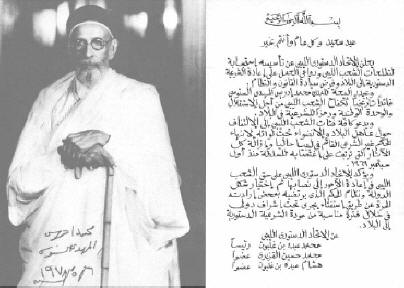
In the name of God, the
Merciful, the Compassionate.
The Libyan
Constitutional Union hereby proclaims its institution in deference
to the aspirations of the Libyan people and the exigencies of
seeking to restore constitutional legitimacy to the nation and to
re-establish the rule of law and order.
The Union
reiterates the pledge of allegience to King Muhammad Idris al-Mahdi
Sanusi as historical leader of the Libyan people's struggle for
independence and national
unity and as a
symbol of legality for the nation.
It calls upon
all Libyans to rally around their monarch and under his banner to
put an end to the illegitimate regime now existing in Libya and to
eliminate all the consequences that have accrued from its usurpation
of power since September 1st 1969.
The Libyan
Constitutional Union emphasizes the right of the Libyan people to
restore justice and thereafter to decide such form of body politic
and system of government as they may choose of their own free will
in a referendum to be conducted under international supervision
within a reasonable period from the restoration of constitutional
legality to the nation.
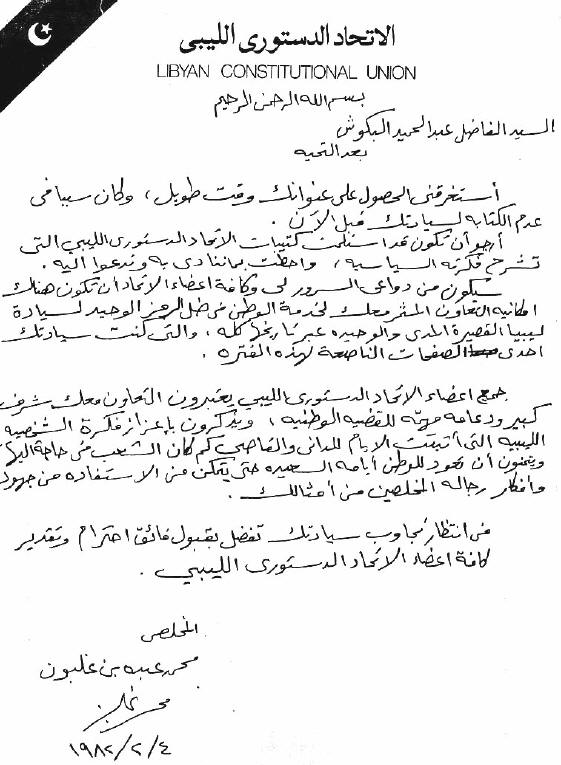
A translation of a letter sent to Mr Abdulhameed El-Bakoosh:
The honourable Mr Abdulhameed El-Bakoosh
Greetings!
It has taken me a long time to obtain your address and that is the
reason of not writing to you until now. I hope that you have
received the Libyan Constitutional Union Booklets which explain its
political idea and what we strive to achieve and stand for.
I and all members of the Libyan Constitutional Union would be
pleased if there is a possibility of fruitful cooperation with you
to serve the homeland in the shadow of the only symbol of the Libyan
sovereignty which was short in duration and unique in the entire
history of Libya. Furthermore, you were one of the brilliant pages
of this period.
All the members of the Libyan Constitutional Union consider
co-operating with you a great honour and an important
consolidation
of the national cause and they remember with pride and appreciation
your idea of the
"Libyan Personality"
which time has proven how much the people were in need of and they
wish for the return to the homeland its happy days so that it can
make use of the efforts and ideas of the sincere people like you.
While waiting for your response, estimable sir, please accept the
highest respect and appreciation of the entire members of the Libyan
Constitutional Union
Sincerely,
Mohamed Ben Ghalbon
4/2/1982
بسم
الله الرحمن الرحيم
Part (4)
(First published in Arabic on
15th July 2006)
[2] Announcing the Establishment of the
Libyan Constitutional Union
Cont. Abdulhameed El-Bakoosh:
In the
previous part of this documentary article, I stopped at Mr.
Bakoosh’s phone call from London in which he informed me that having
received our correspondence regarding the formation of the LCU, he
was coming to Manchester to meet me to discuss the matter.
Mr.
Bakoosh arrived at my house in Manchester the following day, and
that was the first time I met him.
After
welcoming the honourable guest first in my house, we moved to the
LCU’s headquarters to discuss the matter in hand. There waiting for
us were Mr. Mohamed Al-Gazieri and my brother Hisham.
We talked
extensively for a few hours about the LCU, its motives and aims.
Our discussion revealed to me that Mr. Bakoosh had, from the outset,
a deep understanding and appreciation of all aspects of this
patriotic endeavour, which was consistent with his renowned
astuteness, high level of intellect and true patriotism. As such,
there was nothing one could add in this context to some one of
Mr.Bakoosh’s calibre.
Therefore,
I wasted no time to propose to him that he become the head and
leader of the LCU, in order to realise its desired goals, and fulfil
the hopes that were now resting on it. I did that for two reasons:
1.
Mr. Bakoosh possessed tremendous political experience, much needed
by anybody on whose shoulders the responsibility of leading the
struggle to return
Libya to
constitutional legitimacy was to fall. Such a task requires certain
political qualifications, polished experience in leadership and
strong regional and international connections, as well as sound and
unquestionable loyalty to the homeland. Mr. Bakoosh possessed all
of these qualities in abundance.
2.
The founders of the LCU were novices to the political stage and
lacked the political credibility, experience and connections which
Mr Bakoosh commanded. One quality they possessed in abundance was
their enthusiasm and dedication to the cause of the homeland, which
motivated and guided them to establish the LCU.
I went on
to assure Mr. Bakoosh that the founders and members of the LCU would
happily follow him and serve under his leadership to achieve the
desired goal.
Mr.
Bakoosh thanked me profusely for my offer, which he saw as a
pinnacle of generosity and selflessness. He then made clear his
inability to accept it because of his distinguished status, which
made it inappropriate for him to accept a position conceded to him
by a group of young people who have no recognised rank.
He went
further in his explanation by saying that the situation would have
been entirely different had the idea of the LCU been his brain
child. Only then would leading this establishment be a natural and
logical consequence. But having the position conceded to him by a
group of unknown young people is something he could not consent to.
In spite
of my total disagreement with all of what my honourable guest had to
say in this context, I continued the conversation with him to get to
the bottom of his reservation. I assured him that his chairing the
LCU would not imply that he was appointed to such a position as much
as it would simply mean that he, himself, had volunteered to lead it
for the sake of the national cause.
He replied by saying that the fact would still appear to others that
it is purely a matter of appointment by the founders of this
organisation, something unacceptable to his prominent status. He
then added, that the only way around this would be for me to
persuade King Idris to publicly appoint him as chairman of the
Libyan Constitutional Union, as he had done previously when he
appointed him Prime Minster of the Kingdom of Libya.
I was certain then that this particular request was the reason that
motivated Mr. Bakoosh to come and meet me.
Due to my
admiration and high regard for Mr. Bakoosh, whom I respect dearly
for his well known patriotism, I did not shut the door of discussing
the matter further with him. However I made an effort to clarify to
him that his request was neither logical nor fair. King Idris did
not have the authority over the LCU in the manner assumed by Mr.
Bakoosh to appoint him as its head. The King’s authority in this
context emanated from the esteem he enjoys in the hearts of the LCU
founders, who would not refuse the King’s request if he were to make
it. However, he would never do that for the following reasons:
o King
Idris did not found the
Libyan Constitutional Union, and was not concerned with details of
its infrastructure. This matter was left entirely to those who
founded it. The King’s interest in this regard was confined to
blessing this campaign to realise the aspiration of restoring
constitutional life to Libya.
o It
was the founder of the
Libyan Constitutional Union and architect of the idea of restoring
the abandoned constitutional Legitimacy to its proper context,
through rallying around its symbol and around the country’s
constitution, who persuaded the King to give his consent and
blessing to it.
o When
the King gave his approval to this campaign, his implicit
stipulation was that he would not be directly involved in the
political activities of this affair. He had several reasons for
that, among the most important of which are his wish not to be seen
as violating the hospitality of the Egyptian authorities, who had
stipulated that he would not engage in political activities against
the ruling regime in
Libya. A
further equally important reason was the King’s advanced age and
poor health, which could not withstand such
burdensome
duties.
o Taking
into account all the above considerations, the king’s involvement in
the LCU was symbolic and stemmed from the necessity that his
positive response to this mission was considered both a religious
and nationalistic duty, imposed by the hardship endured by the
Libyan people under the cruel and brutal military dictatorship. The
king, who had maintained an ascetic lifestyle and abstained from the
luxuries of life and the trappings which power brought with it would
have never consented or give his blessing to this endeavour
had he not been assured by the architect of the idea of the Libyan Constitutional Union that this
would provide another great service to his nation, to whom he gave
his entire life.
Therefore
there was absolutely no cause to embarrass the King by asking him to
appoint Mr. Abdulhameed El-Bakoosh head of the Libyan Constitutional Union.
In spite
of all my above explanation to my honourable guest, he was adamant
in his refusal of our invitation for him to assume the leadership of
the LCU and steer it towards the aspiration of the Libyan nation,
and held on firmly to his aforementioned condition. I still did not
give up on this distinguished Libyan personality. I informed him
that the offer still stood and asked him to reconsider his final
decision in his own time.
I later
learnt that Mr. Bakoosh had no interest in leading the
Libyan Constitutional Union towards its designed goals when he sent
me publications of the “Libyan people’s Liberation Organisation” in
an obvious hint that he was intent on being actively involved in the
organisation which he established sometime earlier. [1].
*
*
*
*
*
During my
first visit to Egypt after this episode, I was greeted at Cairo
airport by Mr. Bakoosh with his customary courtesy. He expected me
to open the subject of his declining of my offer, but when I showed
no interest in the subject, he instigated a conversation in this
regard. In the context of justifying his refusal, he said that, on
the one hand, he had founded the
Libyan people’s Liberation Organisation in compliance with the
aspiration of the general ideological trend that was prevailing
amongst most of the Libyan opposition at the time. And that he saw
it as the proper political platform to confront the ruling regime in
Libya.
On the
other hand, the idea of the LCU, which was based on rallying around
the person of the King, did not conform with the general mood
currently rife among opponents of the regime. For King Idris was
not at that time a figure of total acceptance among Libyan
nationals, as indeed he was never a universally accepted figure,
either before or during the time of independence!
In his
zeal to articulate those justifications, my host forgot that, by
doing so he had contradicted himself in his previous declaration to
me during our meeting in Manchester, when he expressed his
admiration and total appreciation of the LCU’s approach and
manifesto.
*
*
*
*
*
It is perhaps worth drawing the reader’s attention here to the fact,
that I was absolutely certain that in the merging of the LCU’s,
initiative with Mr. Bakoosh’s numerous abilities and skills lied a
great chance to accomplish the task of ridding our country of the
despotic military regime.
In other words, joining Mr. Bakoosh’s political astuteness,
experienced leadership and wide range of regional and international
connections, with the solid ground and popular appeal of the
principals of the LCU would have inevitably led to the realisation
of the aspirations of the Libyan people.
I firmly believe that squandering that rare opportunity was a
tremendous loss to our national case.
To be continued…
Mohamed Ben Ghalbon
chairman@libyanconstitutionalunion.net
4th
August 2006
ـــــــــــــــــــــــــــــــــــــــــ
[1]
“The Libyan people’s Liberation Organisation”, was one of the Libyan
opposition groupings which emerged at that time. We sent Mr.
Bakoosh a note of congratulations when he announced its
establishment. The name of this organisation was changed shortly
after its establishment to “The Libyan Liberation Organisation”,
bearing the slogans “Liberty, Fraternity and Justice”. The
organisation published a magazine named “The Liberation”. The first
Issue was published in April/May 1983. Towards the end of 1984 wide
cracks started to appear in the structure of this organisation
following a severe and bitter public clash between its founders Mr.
Bakoosh and Mr. Basheer El-Rabti, which eventually led to the
splitting of the organisation into two different bodies. Mr.
Bakoosh remained the head of the “Libyan Liberation Organisation”
and continued the publishing of “The Liberation” for a short while
before both the organisation and the magazine disappeared
completely. While Mr Rabti founded a new body he named “The Libyan
National Organisation”. This organisation published a magazine
named “Al-Mirsaad Allibi”.
|
|
Top of
the Page
Original Arabic
|
|
|
|
|
|
| |
|
This part was published on
8th August 2006 the
following Libyan sites |
|
"Libya
Our Home" ,
"Libya Al-Mostakbal" , "Al-Manara"
|
|
|
|
|
|
|
|
|
|
|
|
بسم
الله الرحمن الرحيم
Part (5)
(First published in Arabic on 28th July2006)
[2] Announcing the Establishment of the
Libyan Constitutional Union
Before
going any further in narrating details of the meetings which took
place between the Libyan Constitutional Union and various Libyan
notables and heads of Libyan opposition groups, I wish to mention
that during our intense campaign of contacting those personalities
to announce the establishment of the LCU, we spared no effort to
convince them of its essential idea of restoring constitutional
legitimacy to Libya.
Furthermore, we had tried all the means at our disposal to urge
these people to adopt this idea and unite under its banner.
We
made conscious efforts in this regard, to afford each one of those
personalities all the due respect, courtesy and recognition of past
and potential prominent future status. On certain occasions we
offered some of these personalities leadership of the LCU. This was
prompted by our keenness to advance the national interest ahead of
our own personal or partisan gains.
However, what had been hoped for from these personalities was not
realised and the results from dealing with them, were not only
disappointing, but shocking for the LCU. Some declared their enmity
towards me, the LCU and its founders (this will be dealt with in
greater detail when the subject of these personalities is raised in
its proper place in this article). This feeling of hostility was
one-sided. We did not reciprocate nor did we respond in kind
On the other hand, some of these Libyan personalities chose to
ignore the LCU completely, not only in their discussions and press
interviews but also in the text of their leaflets and distributed
publications. Among this last group one may mention the following:
Mr Mansour Alkikhia (may Allah bestow His mercies on him dead or
alive), Dr Muhammad Almegrief[1],
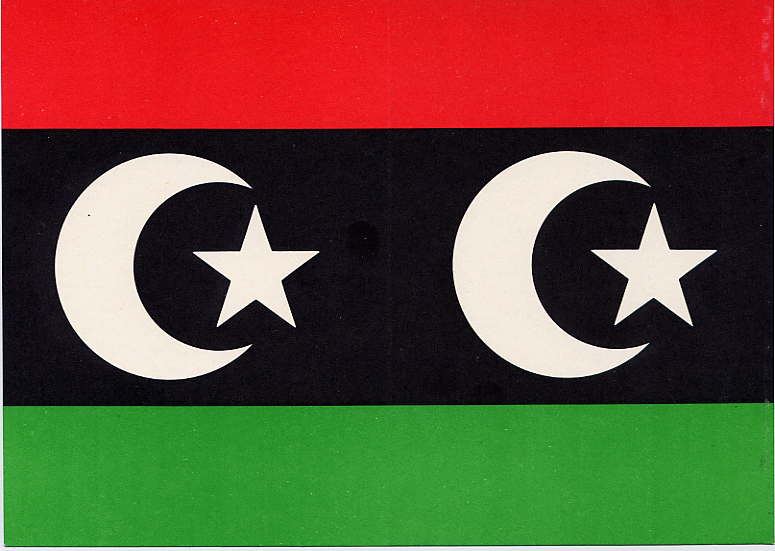
Mr Abdulhamid El-bakoosh and Mr Mustafa Bin-Halim[2].
*
*
*
*
*
Muhammad El-Saifaat
As
mentioned in the first part of this series, I came across Haj El-Saifaat
when I had contacted him (in August 1981) to ask him if he would
inform the intermediary between King Idris and myself about my stay
at my father’s house in Alexandria and my telephone number there[3]
Mr. El-Saifaat
did not like, at all, the fact that I had bypassed him and contacted
the late King through a person other than himself without consulting
him or seeking his permission. El-Saifaat saw himself, as we said
earlier, as the warden of the King’s private and public affairs. He
thought that any contact with the King concerning any matter, big or
small, should only be through him, with his personal agreement and
consent.
And from
then on, this veteran Libyan personality, who enjoyed widespread
popularity among many Libyans, declared his enmity towards me
unnecessarily and without any justification. He was responsible for
an intense campaign of vilification and slander against me
personally and my political orientation as embodied in the
establishment of the
Libyan Constitutional Union,
and rarely missed a chance when he met a group of Libyans, on any
occasion, to attack me and the idea of the LCU.
He was
able to spread his campaign due to his numerous contacts with Libyan
personalities and families that immigrated to Egypt at that time. He
enjoyed these contacts due to the special status that he had during
the monarchist era, which endeared him to many Libyan opponents of
the military regime which had toppled it.
The
affection that many Libyans had for Haj Mohammad El-Saifaat not only
made them listen to him, but made him their centre of attention and
their main source of information. In connection with this matter, a
contemporary of that era once disclosed to me that he considered El-Saifaat
a mobile news agency, who could through his exceptional
conversational skills convince his audience of whatever he wanted to
spread among them.
With this
background which was characterised and dominated by his limiting
vision of the national interest, Haj Mohammad El-Saifaat took me for
an enemy. He thought that I had made an unforgivable mistake when I
did not consult with him concerning my contact with King Idris, and
that I had not followed the protocol, that he himself had set.
Moreover,
El-Saifaat, who was born, raised and later worked in an environment
dominated by a tribal mentality, which dictates that there should be
no political change outside its area of influence.
An
important factor which should not be overlooked, and which is at the
crux of the Libyan make-up is the tribalistic nature of the
country. During the monarchy era certain tribes earned privileged
positions through their distinguished role in the armed struggle
which - coupled with the political campaigning that followed at a
later stage - led to the independence of the country and its
liberation from the hated Italian colonialism.
El-Saifaat’s tribe enjoyed a
prominent role in assuming positions of power which influenced
events throughout the monarchy
Through
this mindset, El-Saifaat saw in the emergence and coming to
prominence, of the LCU a political movement seeking to unite the
popular base around the Constitution and under the constitutionally
legitimate leader. Under these circumstances he saw the
establishment of the LCU as a violation of the rule upon which the
power structure of the monarchy regime was based.
This
particular concept of haj Mohammad El-Saifaat was shared by many
monarchy era personalities of tribal ancestry, whose tribes
participated in the struggle for independence. Furthermore, this
concept was the reason behind the dislike, which some Libyan
personalities had for the establishment in spite of their love,
affection and strong loyalty they felt for the King.
In other
words, the imposition of certain personalities to assume positions
of responsibility in the new born state, as recognition of the role
their tribes had played in the struggle during the Italian
occupation, gave rise to the feeling of antipathy among some
segments of the Libyan people including the
intelligentsia and those who belonged to the urban areas.
This happened after some of the tribal personalities emphasised
their tribal loyalty at the expense of their loyalty to the state
through advancing their tribes’ interests in preference to the
general interest of the country in certain affairs.
The
dissatisfaction of these groups arose because of the favouritism,
which the tribal elements were trying to impose within the Monarchy
regime. This dissatisfaction developed into a political hatred
between the two groups. This hatred was intensified by the
unconstitutional actions of certain tribal elements which led, with
the passing of time, to distort and undermine this refined political
system which unified the nation under a civilized and honourable
banner, immediately after its independence.
On the
other hand, this impassioned hatred ignited the flames of discord
inside the governing authority as embodied in some actions which
exceeded the proper bounds. These actions resulted from the tribal
intolerance and
zealotry
which found its clearest expression in the uncompromising tribal
stance leading to unacceptable political positions. The most
prominent of these positions took shape in the 1964 events which
expressed very clearly the intensity of
difference
in thinking between the city dwellers and some of the rural populace
who played an active role in the exercise of power in that era.
With this
in mind I will now return to the main subject of Haj Mohammad El-Saifaat’s
hostile stance towards me following his discovery of my direct
contact with the King without involving him in the matter. And more
importantly, his stand towards the
proposition that I outlined to the King in relation to the
establishment of the Libyan Constitutional Union whose core idea is
concerned with the return of the constitutional legitimacy to the
country.
Haj El-Saifaat
was dominated in this matter by his tribal bigotry. He perceived
this as an attempt to engulf the King in a national struggle aimed
at changing the government through an idea carrying within it the
seeds of success if the various currents of the Libyan opposition
would rally around it.
Therefore,
according to his line of reasoning, the success of the LCU through
elements belonging to the urban dwellers would lead to the exclusion
of the tribalistic elements, and so according to his assumption,
power would pass on to those who would be responsible for change, as
had been the case with some of the personalities of the tribal
entity following the country’s independence.
In this
way, Haj Mohammad El-Saifaat continued waging his attacks on my
person and The Libyan Constitutional Union in all the Libyan milieus
that he used to frequent at that time. His popularity among the
Libyan residents in Egypt helped him in his campaign, for almost
never a day passed without him being invited as a guest of honour by
one of the Libyan families in Egypt, and he took the opportunity to
slander me and the Libyan Constitutional Union to his hosts and
audience. To the extent that whenever he met my late father in a
social gathering of Libyans, resident in Egypt, he would start
venting his vehement criticism of my political orientations to him,
and condemn my efforts to achieve the desired general consensus on
the goals of the Libyan Constitutional Union. He actually went as
far as blaming my father for not forcing me to desist this
“incitement”.
In one
such occasion, my father had enough of hearing Haj El-Saifaat’s
repeated and exaggerated criticism, which were untruthful
and distorted. He said to him, “Please, Haj Muhammad, don’t talk to
me about this matter again. If you have any reservations or
criticism against my son’s political views go and speak to him by
yourself! My son is responsible for his actions. This is a matter of
his personal freedom and he is responsible for the political views
that he thinks suitable for the realisation of the national
interest.”
El-Saifaat
said to my father “but what your son is doing is in vain and will
not achieve anything for him. The Americans[4]
are on our side. Who is supporting your son?”
My father
replied “Allah and King Idris El-Senusi, are on the side of my son.
And if you think that he will not achieve anything and that his
efforts are in vain then let him alone and no harm or wrong will
befall anybody. Further, he will not harm you, especially, when you
are sure that you will achieve your desired aim by
being allied
with the
Americans.”
El-Saifaat
responded with indignation, “He is dispersing the efforts and
hindering our work”
My letter
to Haj Mohamad El-Saifaat, which was dated 17th January
1982 and contained an insistent call for his cooperation and support
for the declared aims of the LCU[5] did not change his stance toward me and the LCU
To be continued…
Muhammad Ben Ghalbon
chairman@libyanconstitutionalunion.net
30 September 2006
ـــــــــــــــــــــــــــــــــــــــــــــــــــــــــــــ
[1]
Many years after leaving the "National
Front for the Salvation of Libya”, Dr Mohammad Almegrief referred to
The LCU in his Book, “Libya Between The Past And The Present….Pages
From The Political History”. This mention of the Libyan
Constitutional Union is necessary in the context of the nature of
his subject, which in part deals with documenting the history of the
struggle of organisations and groups of the opposition against the
regime in Libya.
[2]
In a press interview conducted by Mohammad
Makhlouf with Mustafa Bin Halim, which was published in Al-Sharq Al-Awsat
newspaper (issue number 5239, 2 April 1993) Mr. Bin Halim was asked
about his opinion concerning the Libyan Opposition abroad at that
time. In his answer Mr. Bin Halim mentioned the known opposition
groups and deliberately ignored the Libyan Constitutional Union.
Makhlouf followed that answer with the Question, “And what about the
LCU?” Bin Halim answered, pretending his total ignorance of the LCU
and lack of his personal knowledge of me, by saying, “Who are they?
I do not know them, therefore I do not comment on them.”
What is
so extraordinary and confounding in this matter is that Bin Halim,
as we shall see later when we discuss his stance, was among the
first personalities that had been contacted to be informed about the
establishment of the LCU and was urged to support its idea.
Furthermore, what makes Bin Halim’s stance confounding and
eccentric, as is expressed in his misleading answer, is the fact
that he is a relation of mine. He is in fact my cousin (my father’s
sister’s son). This is really extraordinary and unusual and one can
find for it neither an answer nor an explanation.
[3]
Part 2 of this series:
http://www.libya-almostakbal.com/MinbarAlkottab/July2006/mohamed_ben_ghalboon_lcu210706p2en.htm
[4]
What is meant here is the American support for the “National Front
for the Salvation of Libya” which Haj Mohammad El-Saifaat was one of
its prominent founders.
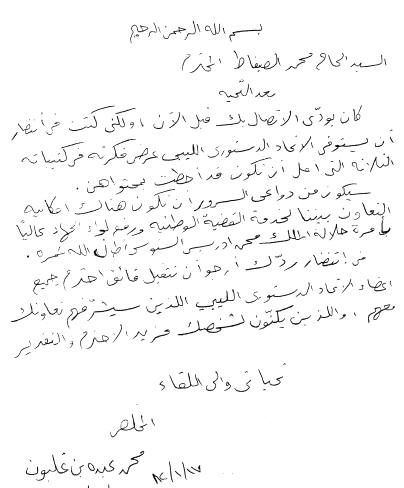
[5]
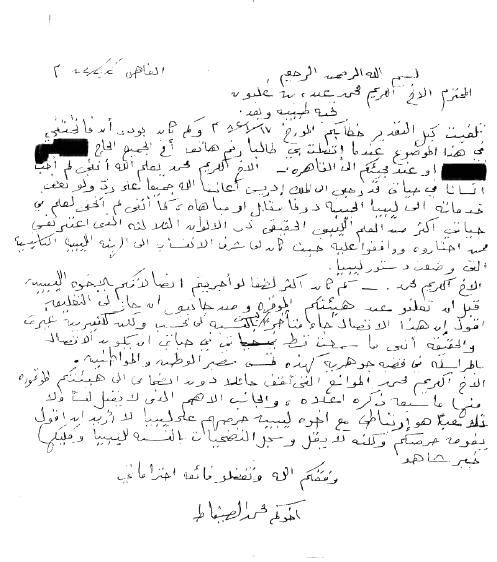
A letter had been sent to Haj Mohammad El-Saifaat, as a part of the
above mentioned campaign to contact prominent national figures. His
reply was negative. (Below are copies of all the correspondence we
exchanged with him)
-----------------------------
Many thanks to Mustafa for undertaking the arduous task of
translating this document from Arabic
Also, a big thank you to Obaid for editing it
----------------------------------------------------------------------
Appendices
Appendix 1:
A translation of the LCU’s letter to
Haj Muhammad El-Saifaat dated 17th
January 1982
In the Name of Allah,
the Beneficent, the Merciful
The honourable
Haj Mohammad El-Saifaat,
17/01/82
Greetings
I wanted to contact you earlier, but was waiting
for the Libyan Constitutional Union to complete introducing its idea
through its three booklets, which I hope you are now familiar with.
We would be happy if there is a possibility of
working together to serve the Libyan cause, and raise the banner of
resistance aloft under the command of His Majesty King Muhammad
Idris El-Senussi (May Allah give him a long life).
While waiting for your reply, please accept the
respects of all members of the Libyan Constitutional Union, who
would be honoured to work with you, and who all hold your person in
high esteem.
Compliments, until we meet
Yours sincerely
Muhammad Abdu Ben Ghalbon
** * **
Appendix 2:
A translation of Haj Muhammad El-Saifaat’s
reply dated 2nd February 1982
In the Name of Allah,
the Beneficent, the Merciful
The honourable brother Muhammad Abdu Ben Ghalbon,
Greetings
Cairo : 02/02/82
I gratefully received your letter dated 17th
January 1982. I dearly wished that you opened this subject with me
when you contacted me to request the phone number of our brother Haj
(.....)[1], or when you came to
Cairo.
Honourable brother, God knows that I never loved
anybody in my entire life as much as I loved King Idris, may Allah
help us all to repay him for at least some of his services to our
beloved Libya, which he offered the country without asking anything
in return. Also, I never bowed to any flag more than the real
Libyan flag with its three colours, which I consider myself among
those who selected and approved it, as I was honoured to be a member
of the original Libyan body which formed Libya’s Constitution.
Honourable brother Muhammad; it would have been
more courteous had you contacted the Libyan brothers prior to
announcing your esteemed establishment. On my part, if I may
comment, I would say that your contact came too late, not just for
me, but for many others. The truth is, I have never in my whole
life heard of contacts regarding such a vital issue, that concerns
the future of the homeland and the nation, being made by
correspondence.
Honourable brother Muhammad; some of the
obstacles that prevent me from joining your esteemed establishment
are those I mentioned above. More importantly, however, the part
that is beyond doubt or trickery is that I am committed to some
Libyan brothers whose concern for Libya, I would not say is superior
to yours, but I would say is not inferior. The record of sacrifice
for Libya and its monarch is the best witness.
May
god help you
Respectfully; Your brother
Mohammad El-Saifaat
[1]
Omitted from document to protect identity of the person
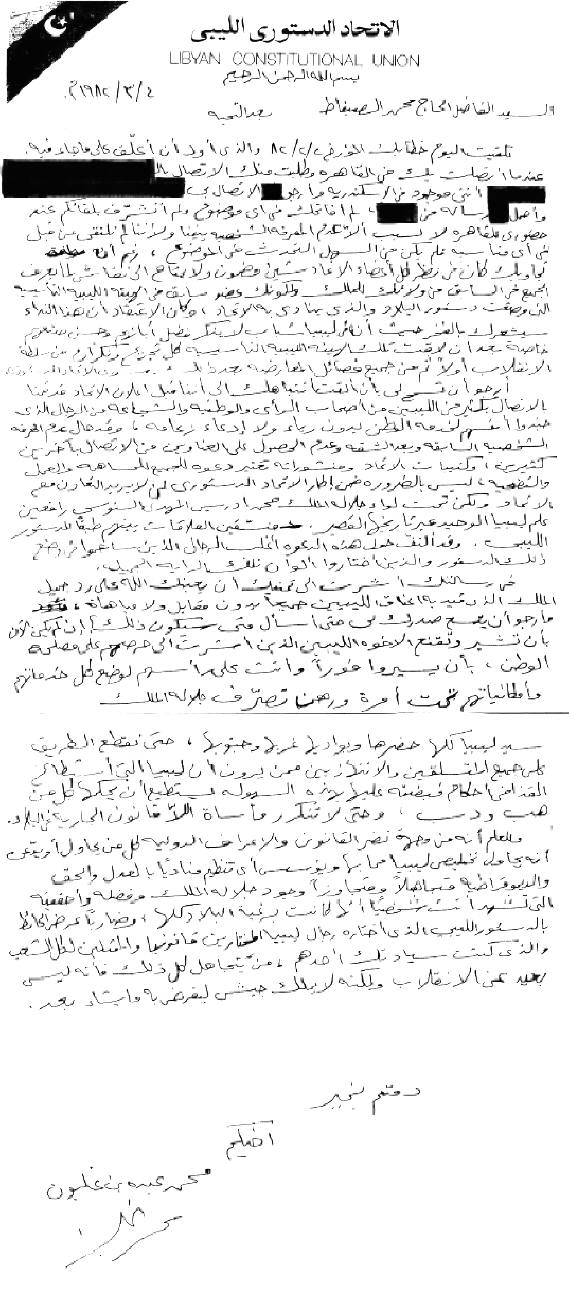
Appendix 3:
A translation of LCU Letter to Haj
Muhammad El-Saifaat dated 4th March 1982
In the
Name of Allah, the Beneficent, the Merciful
The honourable Haj Mohammad El-saifaat
4/3/1982
Greetings
I have today received your letter (dated 2/2/82)
and I would like to comment on its content.
When I contacted you in Cairo and asked you to
get in touch with (.....) to tell them that I was in Alexandria and
I would like them to get in touch with me as I had a message from
(…), I did not discuss any subject with you. Furthermore, I did not
have the honour of meeting you when I was in Cairo, simply because
we did not know each other, nor had we met at any occasion
beforehand. Therefore it was not easy to talk about the subject.
However, all of the LCU members thought that your response was
unquestionably guaranteed to be positive, as a result of what
everybody knows about your past loyalty to the King and your being a
former member of the National Constituent Assembly which wrote the
country’s constitution. This Constitution is what The Libyan
Constitutional Union is calling for.
The belief was that this call would make you
particularly proud of the fact that some young people from Libya are
grateful to their forefathers and are not denying their glorious
deeds. This was especially so as the National Constituent Assembly
was the target of ingratitude and slander, firstly from the coup
d’etat government, and then from all the opposition groups with the
exception of the LCU.
Please permit me to direct your attention to the
fact that before announcing the establishment of the LCU we had
contacted many Libyans known for their vocal opinion, patriotism and
courage and who dedicated themselves to the service of the homeland
without adulation or claims of leadership. Lack of personal
knowledge of many others and the inability to obtain their addresses
prevented us from contacting them.
Furthermore, the LCU booklets and publications
are considered an invitation for all to participate, work and
sacrifice - not necessarily within the framework of the LCU, for
those who do not want to co-operate with it - but under the banner
of His Majesty King Mohammad Idris El-Mahdy El-Sennusi, raising the
only flag that Libya ever had during its short history and
coordinating the relations among themselves according to the Libyan
Constitution. Most of the people, who participated in the writing
of the Constitution, were united in following these ideals. These
are the same men who chose the colours of that beautiful flag.
You referred in your letter to your wish for the
help of Allah (SWT) to enable you to repay the debt to the King and
return his favour, which he bestowed on all the Libyan people with
neither boasting nor asking them for anything in return, and which
made all the Libyans indebted to him.
I am relying on your magnanimity to allow me to
ask you when this debt will be repaid if not now by advising and
convincing the Libyan brothers, who you stated in your letter are
conscientious about the interests of the
homeland, to make themselves and services – with yourself at the
forefront - at the immediate disposal of his majesty the King.
For the King, is the master of all Libya, Urban, Bedouin,
West and South. In this way we combat the opportunists who saw in
the ease with which Gaddafi tightened his grip on Libya an
invitation for them to be its next rulers.
Furthermore, this is also the way to prevent the
sad state of lawlessness prevailing in Libya from ever happening
again.
It is also to be noted that according to
International Law and legal customs, anybody who attempts, or claims
to be attempting, to rescue Libya from its current woes by
establishing an organisation that calls for justice, right and
democracy while ignoring and bypassing the King, whose rights and
entitlement were granted by the whole country, as you can personally
attest to - or one who dispenses with the Constitution which was
written by men, including you yourself, who were legally chosen by
the Libyan people as their representatives - is not that much
different to the one who staged the coup d’etat. The only
difference is they lack the army, as of yet, to impose their will.
May you always be well,
Your brother
Muhammad Abdu Ben Ghalbon
(......) Omitted from document to protect
identity of the person.
|
|
This part was published on
30th September 2006 the
following Libyan sites |
|
"Libya
Our Home" ,
"Libya Al-Mostakbal"
|
|
|
|
|
|
Top of
the Page Original Arabic
|
|
|
|
|
|
|
|
|
|
بسم
الله الرحمن الرحيم
Part (6)
(First published in Arabic on
11th September 2006)
[2] Announcing the Establishment of the
Libyan Constitutional Union
Mustafa Bin-Halim
As soon as I
returned to Manchester from my initial meeting with King Idris, I
decided to visit my cousin, the former Libyan Prime Minister Mr.
Mustafa Bin-Halim in his home in London. For many years I had
maintained a habit of paying him social visits since his exile on
every opportunity that I was in London either on business or on
holiday. This custom never stopped even when I was still living in
Libya where the oppressive Libyan regime made it known that contacts
with exiled political figures of the monarchist regime would be met
with severe punishment.
The main reason for this particular visit was to inform him of my
plans to form the Libyan Constitutional Union. This would make him
one of the first Libyan dignitaries to learn of this matter.
After having lunch with Mr. Bin-Halim and his family, I asked to
talk to him privately about a particular subject.
He led me to his
private study where I disclosed to him my intention to establish the
Libyan Constitutional Union with the aim of restoring Constitutional
legitimacy to Libya under the banner of its rightful symbol and
legal representative King Idris I.
We had a very long and extensive conversation, which I will convey
here to the readers in all its meanings and conclusions, rather than
literally word by word as it took place some quarter of a century
ago.
I began by
elaborating in my explanation to Mr. Bin-Halim the idea of the LCU
in all its political, legal and spiritual aspects without referring
to my actual encounters with King Idris and my success in obtaining
his consent.
My reason for this
was that I had not yet reported the full details of the outcome of
my meeting with the King to my colleagues at the Libyan
Constitutional Union.
This was in accordance with the organisational obligation towards my
colleagues and out of moral duty and professional courtesy towards
them. I therefore decided not to divulge the news of that important
event to anybody before informing my colleagues in order that a
collective decision in that regard be made.
** * **
Mr Bin-Halim fully comprehended all aspects of the idea upon which
the LCU was based. He expressed his utter admiration of it and said
to me; “Listen grand pa
[1]
this idea doesn’t just offer the Libyan people the chance to break
free from Gaddafi’s regime alone; but it is also the lifeline that
will pull them out of the quagmire caused by their deprivation of
the blessings of this holy man[2].
He went further to
say, “If there was ever a real chance of success to solve the Libyan
problem, bring an end to the ruling military regime and restore the
constitutional legitimacy to the homeland, it would be through this
brilliant idea, which the LCU is founded on. But the great
predicament lies in implementing it and converting it into a reality
on the ground, which was an absolutely impossible task”.
I interrupted him to
ask what made him deem the LCU’s idea impractical and impossible to
realise.
He continued to say that if this idea had any grain of hope of
success he would, himself, have carried it out a long time a go, and
not waited until I grew in age to come and present it to him as I
was doing now[3].
He paused for a second and then went on to say that “the obvious
reason which makes this idea impossible to realise lies in its most
important factor. Namely the consent of King Idris, who, as you are
probably aware, is reluctant to practice politics in any form or
shape. And that he himself knows this fact more than anybody else
for he had first hand experience of it”.
He went on to tell me, “ Even if, for the sake of argument, we
assumed that you went ahead with your plan without the king’s
approval on the basis that you are undertaking a vital patriotic
duty to rescue an entire nation, and therefore you don’t need the
king’s approval. The king would, at that particular point, pull the
rug from under you by declaring to the whole world that he did not
give you a mandate to deal in this matter in his name. He might
even go further than that by declaring to the whole world that he is
bitter about the Libyans who betrayed him after he spent his entire
life serving them, and consequently he wouldn’t want to give them a
helping hand.
I quickly
interrupted him by asking, “What if we managed to surmount this
obstacle by securing the King’s approval? What would your personal
position be then? And what could you offer –in this context- to the
national struggle?
He replied by saying, “This was a fantastic hypothesis which had no
solid ground. So keep us from unrealistic suppositions, as I am
talking to you out of first hand experience. I have previously
talked to the king, on more than one occasion in this regard and he
refused it categorically. All my attempts have ended in total
failure”.
** * **
At that time I did not have any reason not to believe what Mr. Bin-Halim
was saying, yet the facts on the ground forced me not to accept what
he had just told me in his long and articulate speech about the
King’s emphatic refusal to the numerous approaches made by him in
this regard.
I
found myself in a real dilemma, for on the one hand I have just
secured the King’s consent without having any previous contact or
connection of any sort with him. Nor was I ever his prime minister
or an official in his regime. While on the other hand, I was
listening to this veteran politician who had served the King for
many years and as a result developed a strong link to him, telling
me that all his similar attempts with the King ended in failure!
During the course of
the conversation I began to notice then that Mr. Bin-Halim, for a
reason unknown to me, was using all his renowned persuasive skills
to put
me off the idea of
establishing the Libyan Constitutional Union. I thought that he was
possibly doing so out of concern for my personal safety in the face
of the prospective gravity and dangers associated with such a task.
I recall him telling
me, in his demoralising speech “Even if we hypothetically assumed
that you managed, somehow, to obtain the King’s approval, you would
stumble on another obstacle which you have no answer for or power to
overcome. You would be faced with the negativity and lack of support
of the Libyan people, for “your folk
are womenfolk” [4]
** * **
In-spite of all this, I did not give up on trying to extract his
viewpoint, and appraise his stand with regard to the establishment
of the LCU in case we announced it in the near future.
I, calmly and
patiently, asked him to indulge me by hypothetically assuming that
we managed the impossible, and obtained the consent of the King and
his support for the establishment of the LCU. What would be his
personal position towards it? Would he support it as the body that
advocates the national ideals that he reveres and sees as the way to
salvation? Or would other personal considerations in his life
dissuade him from such a stand?
At this point Mr. Bin-Halim was cornered into giving an answer to my
persistent query. He told me, “Listen grandpa; I shall venture with
you in this journey into this impossible hypothesis and assume that
you managed the unmanageable. If you actually obtain the King’s
consent you would then have in your hands the key to resolving the
Libyan case and you would have succeeded in accomplishing something
I personally tried and failed to accomplish. As for my stance
towards this patriotic endeavour and how much support I could give
to it, I am now, as you are aware, a Saudi national. I have, due to
my exceptional circumstances, forsaken practicing politics all
together. I also have personal interests which I would not want to
jeopardise. However, I will be ready to provide you with advice and
all the assistance within my capability. For, firstly you are my
cousin, and secondly I am still a Libyan and the interest of my
homeland is of the utmost concern to me. I do, however, have one
condition”.
I asked what this
condition was.
He replied by saying, “This matter remains a secret between you and
me only, without involving anybody else. Meaning that the two of us
sit together like we are doing now, I provide you with the needed
advice and arrange for the required assistance”.
I
accepted his generous offer and thanked him profusely for it and
said to him that I have one more request which I think lies within
his capacity. He asked what it was. I told him, “When I come to
establish the LCU, I would be in great need of his wide range of
contacts with the leading and influential political figures in the
Arab world. He warmly said to me “I would not spare any effort in
this context”. I left the residence of Mustafa Bin-Halim fully
content and happy with his promises.
** * **
Shortly after that
meeting, my colleagues at the LCU and myself set a date to publicly
announce the establishment of the Libyan Constitutional Union. We
chose the 7th October 1981, which marked the 30th
anniversary of the declaration of the Libyan Constitution, and which
coincided that year with the Muslim event of “Eid Al-Adha”. We
printed the proclamation of the LCU on a greeting card for that
auspicious occasion, and included with it a rare photo of King
Idris, which until recently sat on a table at the entrance of the
King’s residence, and which he bestowed on me to use in the
proclamation of the LCU.
I
sent one of these cards to Mr. Bin-Halim, as we did with other
Libyan notables in exile[5],
and on the morning of the day of Eid Al-Adha I rang him, as was my
custom, to pay my respects and wish him Eid Mubarak. He interrupted
my greetings with extreme frostiness, which stopped me from
continuing my compliments. He told me in an angry tone, “I received
your piece of paper” referring scornfully to the greeting card I had
sent him. I could hardly believe my ears, for this was far from the
response I had anticipated or the etiquette expected from this
veteran and articulate speaker. I wrongly guessed that he might be
angry with me because I announced the LCU before telling him in
advance. Something I could explain and hopefully justify to him.
However, I could not for one moment imagine that the matter would go
far beyond all that, and that that frostiness and anger would be the
start of an animosity which would extend to the next 25 years.
My astonishment was compounded when his words started to
hysterically flow in total contrast to the image I had of him in all
those years. His hard words felt like a heavyweight boxer’s blows
and were a cause of grave stress and disappointment to me which took
me a very long time to recover from. To this day I can not find a
logical explanation to what made him feel that way[6].
He continued, “I
want you never to call me again after this time! Never to send me
any cards or letters, in this context or any other matter. I want
you to also forget that we are relatives, and tear out the pages
that contain my contact details from your diary. . From this moment
on, I do not want to see you or know you!!”
I replied “Eid
Mubarak Mustafa Bey” and put the phone down.
My direct contact
with him ended that day. I thought then that each of us would go
his own way, but that our blood relation would preserve a degree of
respect for one another. I was completely wrong. For Mr. Bin-Halim
chose a course which was totally unbecoming of his character, age or
rank. With no apparent reasons or justification he took me for a
bitter enemy and unleashed a vicious campaign to tarnish my image on
three fronts, relatives, friends and on the general level. He made
the task of my character assassination a priority to which he
unscrupulously employed all measures.
** * **
He began by spreading rumours among members of the Libyan
Opposition, with some of whom I had friendships and mutual respect,
that I had fabricated the King’s consent, that I was mentally
disturbed and that I was a disobedient son who defied the family’s
elders, who did not approve of the idea of the Libyan Constitutional
Union.
He then turned his attention towards my late father, who held him in
high esteem and had faith in his political astuteness and
judgement. He thought of him as a veteran politician who held
political office over long periods during the monarchist era of
Libya, and who was skilled in the tricks and mischief of the world
of politics.
He employed his brother Mr. Abdulhameed Bin-Halim, a lawyer, whose
esteem with my father was not inferior to that of his brother, and
who was a very sweet and smooth talker with an ability to captivate
his audience.
The two alternated
in attempts to convince my father to put me off continuing with the
path I had chosen in my quest to liberate our country. They took
turns in spreading fear and anxiety in my father’s mind, and tried
to convince him that what I was doing would bring grave consequences
not only on myself but on all the Ben-Ghalbon family. They used the
regime’s notorious record of brutality and bloodshed against its
opponents to convince my father that his entire family would suffer
as a result of my reckless action.
It is also worth mentioning in this context that Mr. Abdelhameed
Bin-Halim, was one of the founders of the Libyan Front for the
Salvation of Libya (NFSL) and among its prominent figures in Egypt,
he did not stop at scaring my father with tales about the wrath of
the military regime, but he went further to “advise his
uncle” that the future of Libya is definitely with the
National Front, which was not looking with satisfaction at what his
son is doing, something which would inevitably jeopardise my
father’s long term plans when he returns to Libya. Thankfully, my
father’s solid faith in my judgement spoilt their scheme.
I must admit,
however, that Mr. Bin-Halim’s wider campaign generally caused much
harm and hampered my efforts. Some relatives and friends took a
negative stance towards me as a result of the doubts he spread
amongst them. On top of that, Mr. Bin-Halim’s negative reports of
me when consulted by various Arab governments had a major influence
on their decision not to stretch a helping hand to the LCU.
** * **
Away from falling into forming opinions coloured by sentiments or
personal stances. If we calmly analyse what happened we would come
to the logical conclusion that the Libyan Constitutional Union had
yet again lost the contribution of a prominent and capable figure,
who might have made a significant difference in our country’s
struggle to rid itself from the brutal and backward military regime,
and realised the Libyan people’s dream of regaining its dignity and
freedom. The loss of the vital services of former P.M. Bin-Halim,
who unjustifiably took a hostile stand from this patriotic
endeavour, was no less significant than the loss of the contribution
of P.M. Bakoosh.
To be continued
Mohamed Ben Ghalbon
5th October 2006
chairman@libyanconstitutionalunion.net
________________________________________
[1] Mr. Bin-Halim often
called me jokingly “Grandpa” due to my almost identical resemblance
in appearance to our grand father, whom I also share his name.
[2] Meaning King Idris,
for Mr. Bin-Halim was, like many Libyans, a believer in the
blessings of descendants of the noble line
of prophet Mohamed (SAW).
[3] I was of the age of
possibly his youngest son. By
saying that Mr. Bin-Halim
was hinting that in spite of the quality and merit of the idea I am
presenting to him, it is not in fact new to him and that he wouldn’t
have waited until I grew up and discussed it with him, as he had
thought of it a long time ago.
[4] Mr. Bin-Halim used
an old Libyan term for women. What he meant was obvious; the Libyan
people were not up to the task.
[5] Part 3 of this
series.
[6] A few years on, the
“Washington Post” published an article on 12 Jun 1985 by the veteran
columnist Jack Anderson and Dale Van Atta, who are widely known to
have sources in the US government. The article referred to Mr. Bin-Halim’s
role in the Libyan opposition. I have translated here the paragraph
that deals with this particular detail and enclose below a copy of
the full article.
“The Saudis have
provided at least $7 Million to the NFSL. They use Mustafa Bin
Halim, a former prime minister of Libya who is now an adviser to the
Saudi government, as go-between with Magarieff”.
___________________________________________
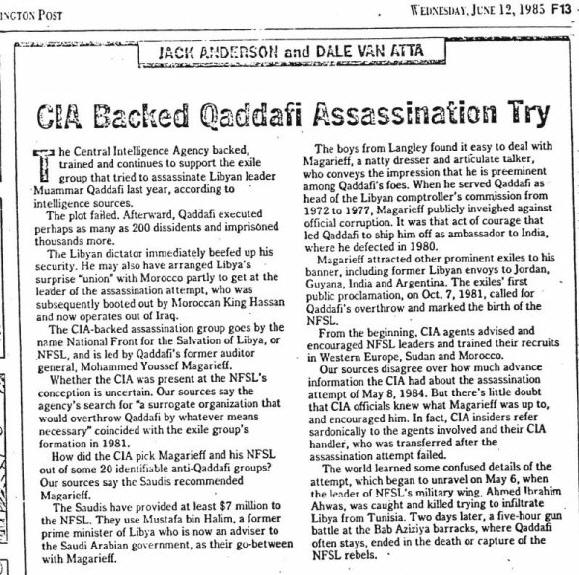 |
|
|
|
|
|
|
|
This part was published on
6th October 2006 the
following Libyan sites |
|
"Libya
Our Home" ,
"Libya Al-Mostakbal"
|
|
|
|
Top of
the Page Original Arabic
|
|
|
|
|
|
|
|
|
|
بسم
الله الرحمن الرحيم
Part
(7)
(First published in Arabic on
29th August 2006)
[2]
Announcing the Establishment of the
Libyan Constitutional Union
Ramadan Salim El-Kikhia
Haj Ramadan El-Kikhia
(God bless his soul) was considered
among the most prominent of Libyan nationalist figures in the city
of Benghazi. He was renowned in his generation for his true
patriotism and concern for the good of his country. He never
refrained nor was unwilling to give his utmost
for the cause of the homeland and securing its desired
nationalistic goals.
He was also one
of those nationalist activists who established the Omar Mokhtar
Association, which was famed for its sincere aspirations for the
Libyan nation. The Association achieved significant gains in the
field of spreading political awareness and cultivating a general
patriotic sense amongst the ordinary Libyan citizens within the
domain of its purposeful social and political activities.
Although Haj
Ramadan had, in the years that followed the country’s independence,
some reservations about the flaws in some aspects of the ruling
system of the new born state which stemmed from the tribalistic
domination and bigotry that blemished some corners
of government then. He was at the same time an ardent
believer in the necessity of holding on to the constitutional
legitimacy which extracts its sanctity from the constitution that
was written by representatives of the Libyan people in the years
that led to the country’s independence.
As such, Haj
Ramadan’s admiration of the idea that formed the core of the Libyan
Constitutional Union, and his total support of its aims came as
absolutely no surprise. It was only natural that this nationalistic
seasoned veteran fully comprehended and fathomed the depth of the
goals of this idea in all its aspects.
Haj Ramadan El-Kikhia
immediately recognised the genuine goal that formed the basis of
this idea as being the return to the Constitutional legitimacy,
making it the backbone upon which the ruling system of Libya should
rest. He did not confuse it for being a call for the return of
monarchist rule as a target in itself, as did many others, who due
to a deficient and myopic vision limited the call of the LCU to
merely a call for the restoration of the monarchy.
El-Kikhia was
not the only person to deduce the true aim of the proposed idea of
the LCU. A few others shared his clear understanding; among them
were veterans such Abdulhameed El-Bakoosh, Mustafa Bin-Halim, Mansur
El-Kikhia and Mohammad Benyounis. They all fully grasped that the
objective of the idea of the LCU was to work towards restoring the
constitutional legitimacy which was chosen by the entire Libyan
nation prior to the declaration of independence. The Libyan people
then chose the monarchist system as a form of government, which was
a prevalent form of modern government in those days. They then
elected Mohammad Idris El-Senussi as King, in a parliamentarian
framework that draws its legitimacy from articles of the
constitution which were written by representatives of the Libyan
people in the period that preceded the declaration of the country’s
independence. As such, King Idris became the legitimate
representative of the constitutional authority that reigned in the
state.
This could not
be abrogated by the military coup d'état which came to power through
illegitimate means. Nor could those bandits annul the authority of
its bearer; King Idris. For although the army rebels have, in
effect secured power through the force of arms, and consequently
managed to rule the country with an iron fist, they remain in the
eyes of international law an illegitimate government.
Equally, it was
the right of the Libyan people –at that time- to combat this
illegitimate regime and work towards restoring the lost
constitutional legitimacy by re-instating
its surviving bearer, King Idris, to resume his role as ruler
of the country. That would be in accordance with the will and
choice of the Libyan people, who bestowed this legal status,
emanating from the national constitution, upon His Majesty from the
outset.
Consequently the
task of restoring this constitutional legitimacy to the country
became the duty and responsibility of the segment of Libyan society
which enjoyed a level of political awareness. At the pinnacle of
this segment were individuals who had a proven record of tirelessly
and sincerely serving their country and who are usually referred to
as the “wise and influential”[i]
of society. It is widely known that people in general, although
more commonly in third world societies, tend to look towards these
sincere, patriotic, educated and experienced elite for help in
leading the struggle towards achieving their aspirations.
** * **
As such, the
task of restoring constitutional legitimacy to Libya had to be led
by these peers of the Libyan society who would take it upon
themselves to combat the despotic and illegal regime that is ruling
Libya. This could be achieved through various means including the
legal channels where pressure could be exerted in international
legal congregations to show that the incumbent regime in Libya is
illegitimate and non-representative of the aspirations of the
people. And thus demand that the international community take the
side of the Libyan masses and help them restore their plundered
constitutional legitimacy. The case is particularly solid given the
fact that this constitutional legitimacy was born through a United
Nations’ resolution.
In addition to
this fundamental channel, other effective means to make the Libyan
masses more aware of their legitimate and fundamental right to live
in the protection of their constitution should simultaneously be
pursued. Raising the awareness that this constitution was the
cornerstone upon which the first Libyan state, throughout history,
was built, and subsequently urging them to fight the rule of the
junta which usurped power through illegal means.
Furthermore, a
considerable number of Libya’s “wise and influential” should renew
allegiance to King Idris – while he was still alive – as the symbol
of this legitimacy. This would be in full compliance with the power
and authority of the constitutional legitimacy which granted him the
post of ruler of the country when it was established in the era
immediately prior to independence.
In the case of
the impossibility of the king’s return to resume his role, it would
return to the Libyan people to choose the system of government they
see fit and suitable for them. And also to elect the person whom
they see fit to rule the country.
That is to say,
the presence of the king on the forefront of this endeavour would
bolster the call for the restoration of constitutional legitimacy
before the International community, for he is its living symbol.
However, on the other hand, the absence of the king would not mean
in any way the diminishing of this legitimacy which originates and
extracts its power and vitality from the people through the
constitution.
Unfortunately
some failed to see this distinction when the idea of the Libyan
Constitutional Union was introduced to them linking it instead to
the restoration of the monarchy, or even with the return of the King
himself. They failed to recognise the fact that the constitutional
legitimacy which was established by the entire Libyan people on the
eve of independence is in fact a vital cornerstone in the build up
of the Libyan state. And therefore, it is not tied to a person or a
particular ruler, nor linked to one form of government in
particular. No one person has the power to revoke it, because it is
a collective contract delivered by the entire Libyan nation, which
fashioned its basis and articles within a constitution that was
written to serve as the guardian of the rights of its citizens and
regulator of its prospective rulers.
Therefore, in
the case of the presence of the King, he would be afforded a new
pledge of allegiance to resume his role through the constitutional
legitimacy which he represents by a mandate from the Libyan people.
However, in case of the King’s reluctance, or absence, the
constitutional legitimacy would force itself through a referendum to
be conducted in a democratic way in which the people at large would
determine the form of government they so desire (monarchy, republic
etc....), as well as the person or persons who should be entrusted
with leadership according the constitution, which would be amended
and updated to accommodate the new choices of the people.
Haj Ramadan El-Kikhia,
as I mentioned above, was not the only “Wise and Influential” Libyan
personality to accurately recognise and comprehend this concept of
the LCU as elaborated upon above. Few other peers of the Libyan
society shared this understanding.
I maintained a
habit of calling on Haj Ramadan El-Kikhia in Alexandria whenever I
travelled there to visit my father, the two had a very close long
standing friendship. We would talk about the Libyan Constitutional
Union and its activities. He very generously passed on his
observations and remarks which were rich in experience. He
was (may Allah bless his soul and make heaven his final abode) among
the very few who awarded me moral support in a time when many others
didn’t find it in themselves to be so generous.
** * **
Sheikh Mansur El-Mahjoob
From the outset,
the founders of Libyan Constitutional Union made a conscious effort
to approach the Libyan personalities who enjoyed a special status in
the Libyan society and who were collectively accepted as belonging
to “the wise and influential”, as they were considered to possess
the vision to determine the right path that could be followed by the
people to achieve their aspirations.
With this in
mind, we contacted former Prime Minsiters; Mr Mohammad Othman Essaid,
Mr. Abulhameed El-Bakoosh, Mr. Mustafa Bin-Halim, as well as
prominent figures such as Haj Muhammad El-Saifaat, Mr. Mansur Rashid
El-Kikhia, Haj. Rajab Bin-Katu, Haj. Ramadan Salim El-Kikhia, Mr.
Mohammad Benyounis and Sheikh Mansur El-Mahjoob. They were followed
by other notables whom we shall cover in detail in later parts of
this series.
Sheikh Mansur
El-Mahjoob, who occupied several prestigious positions during the
monarchy in Libya[ii],
was at the time a political refugee in Saudi Arabia. He lived in
Makka in the vicinity of the holy shrine.
I dispatched the
LCU’s booklets which announced the establishment of the LCU and
elaborated its motives, aims and aspirations by post to his address
in Saudi Arabia. I shortly followed those with a personal letter to
appraise his impressions of the LCU’s idea. I received a reply from
Sheikh Mansur informing me that he did not receive any publications
from the LCU[iii].
I passed on to him a new set of copies through a trusted courier
who handed them to him personally. He told my envoy that he thought
this was a commendable idea and “May Allah bless those who are
responsible for it.”
He went on to
tell my messenger that after receiving my initial letter and his
reply to it, he learnt more about the Libyan Constitutional Union
from some people who were aware of its formation. He said that he
fully appreciated the crux of its idea, and that he admired it, and
immediately thought that it was the brainchild of Mustafa Bin-Halim,
or at least that Bin-Halim was the motivating force behind its
coming into the open[iv].
El-Mahjoob linked my relationship to Mustafa Bin-Halim to the
establishment of the LCU, and thought that Bin-Halim must have used
me as a front for the strife to restore the constitutional
legitimacy to Libya!
On the one hand,
El-Mahjoob reasoned, Bin-Halim would admire such an idea, and on the
other hand, the fact that he was my relative would have obliged him
to lend his support.
Furthermore,
Sheikh Mansur El-Mahjoob went on to tell my messenger that,
according to this wrong assumption, he went on to congratulate
Mustafa Bin-Halim on the first occasion he met him afterwards. He
was shocked by Bin-Halim’s angry reaction. He deplored him for
daring to assume a link between him and the Libyan Constitutional
Union, which he described as a ridiculous proposal and described its
leader as insane.
Sheikh Mansur
continued to state that he had never seen Mustafa Bin-Halim this
angry in all the years he knew him. In his rage he advised Sheikh
Mansur to stay away from the LCU, and to never forget that he was a
political refugee in Saudi Arabia, where political activities by its
guests are intolerable.
He offered his
apologies to my emissary for not being able to join the LCU or
provide it with any assistance, in-spite of him holding it in high
esteem and praying for its success in achieving its goals.
I had no further
contact with Sheikh Mansur El-Mahjoob until 1997 when I met him for
the first time during a trip to the holy city of Makka. He welcomed
me warmly and jokingly told me “Why did you not keep your black hair
as appeared in your photograph with King Idris[v]?
The case for restoring constitutional legitimacy is in need of the
young people of Libya not the old ones with grey hair. In the
past decades the prevailing belief was that the monarchy in Libya
–which represented the constitutional legitimacy in the country-,
was always linked to the elderly. Your call for its
restoration through the LCU came about to dispel this belief and
prove that constitutional legitimacy was aspired to even by young
Libyans.”
** * **
Rajab Bin-Katu
Haj Rajab Bin-Katu
was also one of the prominent personalities of Libya. He filled a
ministerial post during the monarchy, and was among the decision
makers in parts of that era. He was known among his contemporaries
to be resolute and of strong mind in what he believed in.
I contacted Haj
Rajab at the early stage of announcing the establishment of the LCU
to inform him of the crux of its idea and principles through the
hitherto mentioned booklets and publications in a similar fashion to
other Libyan notables whom I have mentioned previously.
Mr. Bin-Katu’s
reply came in a very warm letter in which he expressed his deep
affection towards me and his moral support to my goals as manifested
by the idea of the LCU.[vi]
Although Haj
Rajab Bin-Katu never joined the LCU, nor did he participate in, or
provide for its activities, he maintained a constant moral support
to it. Furthermore, he was of colossal support to my late father[vii]
in the face of the vehement campaign led by Haj Mohammad El-Saifaat
and Abdulhameed Bin Halim, which we mentioned earlier (part 5).
It is worth
mentioning in this context a particular incident which took place in
Alexandria to illustrate the depth of Haj Rajab’s backing of my
father at that time.
They were both
guests at a dinner banquet attended by most Libyans living in
Alexandria at that time. At the head of that banquet were Haj
Mohammad El-Saifaat and Mr. Abdulhameed Bin Halim. The two and a
few of their followers began their usual barrage of provocative
criticisms directed at my father regarding my political activities.
The comments soon turned to condemnation and were far from objective
or constructive criticism. After failing to convince them to
maintain subjectivity and courtesy, my father found himself forced
to abandon the social gathering and leave the scene. Haj Rajab was
the only one among the attendants who departed in solidarity with my
father, as a protest to that unacceptable behaviour.
To be Continued....
Mohamed Ben Ghalbon
12 October 2006
chairman@libyanconstitutionalunion.net
[i]
I have used this term as a translation of what is known in the
Arabic language as:“أهل
الحل والعقد “
[ii]
Sheikh Mansur El-Mahjoob was the head of Libya’s Supreme Court
as well as the Dean of the University of Mohamed Ibn-Ali El-Senussi
for Islamic Studies.
[iii]
A copy of
Sheikh Mansur El-Mahjoob’s
letter is attached below (Appendix No.1).
[iv]
Sheikh
Mansur El-Mahjoob was not alone in believing that the idea
behind the establishment of the LCU was of Bin-Halim’s design,
or at least that he fully supports it. This notion was shared
by many others.
[v]
He was
referring to the change in my appearance since that photo which
was taken with the King in the beginning of the Eighties. My
hair and beard were black with no single grey hair then, while
when I met him my hair was all grey.
[vi]
A copy of Mr. Bin-Katu’s letter is attached below (Appendix
No.2)
[vii]
Haj Rajab Bin-Katu and my father had a very close and durable
friendship which went back many decades.
Appendix No. 1
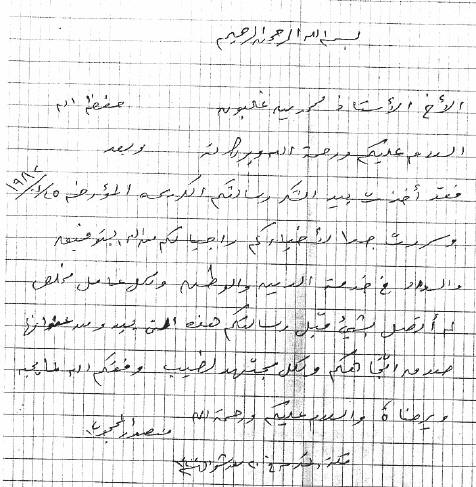
Translation
of Letter from
Sheikh Mansur El-Mahjoob
In the name of Allah,
Most Gracious,
Most Merciful.
Brother
Mohamed Ben Ghalbon (May Allah protect him)
Salaam and Greetings,
I have gratefully received your kind letter
dated 25/07/1982. I was very pleased by your news. I wish you
and all sincere workers success and guidance from Allah in your
efforts to serve the religion and the homeland.
I did not receive anything from you prior to
this letter, which shows from its heading the sincerity of your
intentions. May Allah help you to what he desires and what
would please him.
Peace and mercy of Allah be upon you.
Mansur El-Mahjoob
Makka Mukarrama
20th Shawal 1402
Appendix No. 2
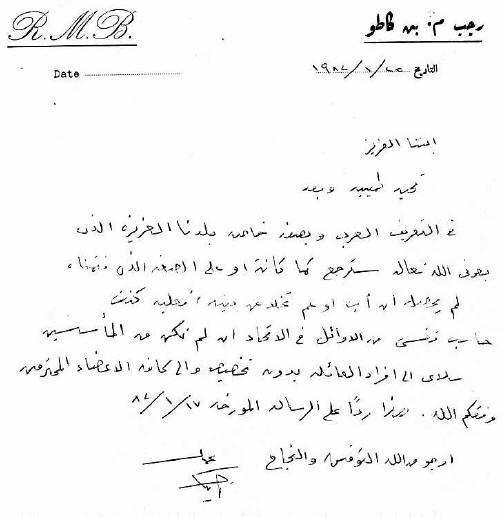
Translation
of Letter from
Haj Rajab Bin-Katu
My
dear son
25/01/1982
Greetings
In the Arabic
tradition, and especially so in our beloved country, which God
willing shall return to what it was and better, no father or
uncle had ever abandoned his son. Therefore, I have always
considered myself to be among the earliest members of the LCU if
not one of the founders.
Regards to all
family members and the respected members of the LCU.
This is a response
to your letter dated 17/01/82
May God help you
and grant you success.
Your Uncle,
Rajab Bin Katu
|
|
|
|
|
|
This part was published on
14 October 2006 the
following Libyan sites |
|
"Libya
Our Home" ,
"Libya Al-Mostakbal"
|
|
|
|
Top of
the Page Original Arabic
|
|
|
|
|
|
|
|
|
|
بسم
الله الرحمن الرحيم
Part (8)
(First published in Arabic on
11th September 2006)
[2] Announcing the Establishment of the
Libyan Constitutional
Union
Hajj Khalifa Azzarouq
Prior
to the establishment of the LCU I had not known or heard of the
Libyan billionaire, Hajj Khalifa Azzarrouq. He was an émigré from
the Ghirian area of Libya and was resident in Cairo where he managed
his business and investments with the privileged status granted to
him by the Egyptian government.
A friend
of mine, who was also one of the founders of the Libyan
Constitutional Union and had a close relationship with Hajj Khalifa
advised me to contact him in order to obtain his financial support
for the efforts of the LCU and make use of his many contacts and
influence in the Arab political milieus, especially in Egypt.
Hajj
Khalifa Azzarrouq did not –at least to my knowledge- enjoy any sort
of national fame or reputation that would enable one to ascertain
his ideology. Nor was he widely known as an intellectual or a
scholar. He was simply a self made businessman who made his fortune
somehow.
It is
important to note, in this regard, that the founders of the LCU, had
at the time of its establishment, adopted a clear policy concerning
the finance of its activities, which was to seek the needed funds
from the well to do patriotic Libyan immigrants.
In
following this policy the founders of the LCU were motivated by
three codes of conduct which where adhered to from the beginning:
-
The
financing of the LCU should be confined to Libyan sources. The
wisdom behind this constraint is quite clear.
-
Making
use of the contacts and influence that some Libyans have in
various Arab and non Arab countries to enlist their support for
the realisation of the national Libyan demands for the liberation
of the Libyan people from this corrupt and brutal regime and the
return of the constitutional legitimacy to its proper place in the
homeland.
-
To
strive to convince some leading Libyan personalities known for
their wisdom, knowledge and influence (the wise and influential)
to assume the leadership of the LCU in order to make use of their
extensive contacts and experiences in leadership.
This
policy was exactly what motivated me to meet Hajj Khalifa at his
office in Cairo. My above mentioned friend arranged the meeting to
take place in December 1982 while I was in Egypt on a visit
dedicated to meetings with other Libyan notables residing in that
country at that time. I had high hopes of convincing him of
financing the LCU and to use his influence and considerable
political contacts in the Arab world to publicise our just cause.
I
received a very warm welcome from Hajj Khalifa. We had a deep
discussion about the financing of the activities of LCU. I found
him fully aware of all aspects and aims of the LCU beforehand.
However,
he stipulated that he personally hands his financial contribution to
King Idris himself. I found his condition astonishing for various
reasons, which I tried to articulate them to him as follows:
· King
Idris did not have any direct relationship with the LCU, for he was
neither its head nor one of its members. He was, in this context,
no more than the symbol of the constitutional legitimacy that the
LCU is seeking and hoping to restore.
·
King Idris, from the very beginning, stipulated that he would not be
implicated in the running of the LCU or in any activities associated
with its work or its devised political plans. This was so – as
repeated in various locations of this article- out of obligations to
the host country, and also because his health no longer allowed him
to assume these burdens of responsibility, which he was reluctant to
carry even during his reign as the country’s monarch.
·
I suggested to Hajj Khalifa that even if, by way of supposition, we
ignored the above mentioned reasons we would still be facing another
unsolvable obstacle, namely that the King never, in his entire life
carried any money, or dealt with it. There was constantly someone
who would act on his behalf in these matters. This was also the
case before he became the King of Libya. After becoming the King of
Libya the matter became more pronounced and an employee was
appointed to take care of the financial matters related to his
living expenses. Therefore, the insistence of handing the King
money not belonging to him - because it was meant to cover the LCU
activities – would be discourteous and no use would come of it, only
the insult and psychological harm to the person of the King who
insulated himself from money or dealing with it.
** * **
In spite
of the logicality and the cogency of the above mentioned reasons,
Hajj Khalifa Azzarrouq refused to accept them and persisted in his
demand to at least obtain receipts signed by the King himself and
nobody else.
I told
Hajj Khalifa, that his demand was unreasonable and not logical, for
the matter, as was reasoned above, did not concern the King in any
way; and questioned his insistence on involving the King in
something he had nothing to do with.
I added
that I did not mind arranging an appointment for him for a social
visit to the King where he could enquire about him, his health and
general affairs. I explained that this would offer the king and his
family a sense of warmth and affection which they were in much need
of in their isolation away from home. I further explained to him
that such a visit from a person with the status he enjoyed in Egypt
would bring multifaceted benefit to the King and his family.
However,
for reasons unknown to me but which could be foretold, Hajj Khalifa
refused this offer and my reasoning for it. He was adamant and
relentlessly insisted on the same two points: Either handing the
money geared for the LCU activities to the King himself and
obtaining from him a thank you letter, or getting receipts, for the
donated sums of money, written by the King himself and authenticated
by his personal signature.
After long
and gruelling efforts, to convince Hajj Khalifa Azzarrouq of my
logically argued point of view he argued against it in a way that
was contrary to the basic principles of objectivity and insisted on
his strongly held wrong and illogical opinion. As I was about to
leave without reaching agreement with him, Hajj Khalifa finally
agreed that he, his wife and children would visit the King and
provide him with financial aid as a gift that would help him with
the hardship of living away from home at his old age.
Unfortunately, Hajj Khalifa Azzarrouq did not fulfil any of the
commitments he made. I tried, as did our mutual friend, to urge him
to fulfil his promises, but his response to our communications was
repeated procrastination.
I gave up
on chasing Hajj Khalifa Azzarrouq and didn’t hear about him for
sometime. I then learnt that he had joined the organisation of Mr.
Abdulhameed El-Bakoosh and paid huge sums of money to finance its
activities. Sometime later I learnt that he returned to reside in
Libya after making a deal with the corrupt regime there.
** * **
Mohamed Ben-Younis
In
addition to our personal acquaintance, Mohamed Ben-Younis and I were
related. The wealthy position of his family and the government
offices that he occupied in the two eras, the monarchy and the
military
[2],
bestowed on him a certain prominence, which was enhanced by his
intelligence and notable political and social awareness
His
personality had an aura of gravity and solemnity among his cronies,
who were constantly impressed by the aforementioned attributes. The
attractiveness of these attributes was crystallized in money and
prestige and the behaviour of these companions was neither
considered to be abnormal nor surprising. Further, this behaviour
was not rare nor was it exclusive to these friends of Mohamed Ben-Younis.
From a
different point of view this behaviour is in fact wide spread and
almost considered to be normal among the urban dwellers in the
societies of the third world. A typical example of this behaviour
could be noted in the two cities of Benghazi and Tripoli.
What is
important here, is that this feeling of admiration and awe that the
companions of Mr.Mohamed Ben-Younis had for his remarkable
personality made him the one with the decisive opinion and the
obeyed word whenever they met with him.
** * **
In the
early days of the establishment of the LCU I sent Mr Ben-Younis, who
was resident in Egypt then, the booklets explaining the orientation
of the LCU and a letter to gauge his willingness to co-operate.
However, I did not receive a reply to this letter which I re-sent on
the assumption that the postman was responsible for my not getting a
reply. It later transpired that the postman was blameless on both
occasions in this matter.
[3]
In the
autumn of 1982, Mr. Ben-Younis came to Manchester to visit his
brother Mustafa, who was a resident there, and was accompanied by Mr
Yusuf Al-Shaibani and Mr Ali Al-Sallaak.
Mr Mohamed
Ben-Younis contacted me, and asked me to meet him. I invited him
and his companions to dinner at my house. That gathering lasted
until the early hours of the next morning.
I
immediately sensed that Mr. Ben-Younis’ call was not solely social.
From the beginning he alluded that he came to discuss the nature of
the LCU, and at that point I asked him if he had received my letters
which I had sent to him earlier in the year. He answered
affirmatively and justified his not replying by saying that it would
be more suitable to postpone the matter until he could meet me in
person.
The
discussion centred on the core idea of the LCU and its orientation
which the people present liked and admired. Further, Mr. Ben-Younis
said that he saw this as the right way - if the people would unite
under its banner - to realise the hope and the aspiration of the
Libyan people to get rid of the military regime and the return of
the constitutional legitimacy to the country. At that point I saw
it was opportune for me to offer to him to join the LCU to lead it
toward achieving the desired aim, as I had done with Abdulhamid Al-Bakoush
and Mansour Rashid El-Kikhia, in keeping with the policy that I was
careful to follow.
Mohamed
Ben-Younis asked me for time to think this matter over and to
discuss it with some of his comrades in the arena of the national
endeavour and said that he would reply to my offer at a later time.
I told him that I would be coming to Cairo within the coming months
and I would visit him to get his reply.
I
travelled to Cairo in December of the same year and telephoned Mr
Mohamed Ben-Younis and arranged an appointment to visit him in his
residence to ascertain his reply.
On the set
date I found Mohamed Ben-Younis waiting for me in his home in
Cairo. Also present were some of his close friends, including Mr.
Yusuf Al-Shaibani, Mr. Sami Al-Jerbi and Dr. Mohamed Al-Gandouz.
As soon as
I started explaining the core idea of LCU to Ben-Younis and his
friends Sami Al-Jerbi began attacking King Idris in a provocative
manner. Mr. Al-Jerbi claimed in this attack that the monarchy was
out of date and that it was not desired by Libyans. He condemned
the orientation of the LCU as a certain failure because, in his
opinion, the LCU limited its potential with its myopic
identification with the King and the monarchy.
At first,
I was in control of my temper while Al-Jerbi continued with his
illogical utterances. I was about to refute his claims and convince
him of the falsity of his discourteous assertion, which was neither
objective nor true, however, he did not give me the chance to have a
dialogue with him. He continued in his impolite allegations without
paying any attention to the observed conversation etiquette and
continued in his derision and sarcasm of King Idris (may Allah
bestow His mercy on him) when he said mockingly,
“Is the
King, truly, still alive or is he dead? He is one of the old fossils
weathered by time and long forgotten. I do not believe at all that
he is still alive. I think that the Egyptians have embalmed him, for
they are skilled in the art of the Pharaonic embalming, to be used
as a scarecrow whenever the need arises.”
During
this time of Al-Jerbi’s silly and nonsensical comments deriding the
King without observing the basic rules of good behaviour and
manners, there was nothing for me to do except to rebuke him with a
reply that would force him to follow the rules of polite behaviour
which he did not respect, however, Mohamed Ben-Younis was faster
than me in dealing with this situation by blaming Al-Jerbi for his
shameful and disgraceful utterances.
From then
on, it was not possible to continue talking about the subject that I
came specifically to discuss. The atmosphere of the gathering had
been poisoned by Al-Jerbi’s irresponsible comments, making the
ambience unsuitable for the discussion of the subject. After that
the conversation took a different direction in order for a calming
atmosphere to prevail on the gathering.
At the end
of this meeting, Yusuf Al-Shaibani invited me and the rest of the
people present for lunch at his house after two days to finish the
talk that we had not started yet.
The
meeting finished without discussing the idea of the LCU which was
supposed to have taken place.
** * **
I met Mr
Mohamed Ben-Younis again at Yusuf Al-Shaibani’s home two days
later. He told me that the idea upon which the LCU was established,
was the sound and valid idea for the national struggle to liberate
Libya from the military rule. And he said that sadly, dissidents did
not support this idea.
Mr Mohamed
Ben-Younis continued his speech about the LCU saying that most of
the dissidents belonging to opposition groups and organisations of
considerable weight, did not like the idea of there being different
dissenting currents competing with their groups and organisations.
This was especially the case if these organisations had the
potential elements that would help them in grasping and identifying
the origin and the cause of the disease in the existence of the
military regime and its continuation in ruling Libya.
In other
words, the struggle for the liberation of the homeland from a
“local” corrupt regime would inevitably face national opposition
forces. These forces would reject this regime and strive for its
downfall or its change. However, it is not necessary in most cases
for these forces, of different opposition trends and colours, to
unite in order to achieve the common goal.
This
intense contest regarding the achievement of this noble cause among
the comrades in the struggle, as happened in similar cases in the
world, might even transform them into opponents and fierce enemies.
The origin
of this phenomenon could be traced to human nature, in its constant
egotism and the searching for distinction to the extent that the
protagonists would become enemies and hate each other in the heat of
their competition to realise the desired common goal.
There are
three exceptional cases, in which the forces of the opposition would
unite to realise the nation goal of being liberated from its
oppressors which could be summarised in the following points:
o
When the individuals in these groups would reach the level of
consciousness, transcendence and the human moral advancement, the
individual or the group, with the common interests, would act
altruistically and work for the public interest and not their own
limited personal interests.
·
Secondly, in the case of an accord of a group around a belief and
their unity under its banner then all the personal desires and
interests would vanish in order to realise the main common goal
which is beneficial to all.
·
Thirdly, if the body in power were an occupying entity or foreign
colonialists then the objective would be undisputedly common to all
and therefore, unity and cooperation would be a patriotic duty for
everyone.
In his
detailed speech, Mohamed Ben-Younis continued to say that the active
national opposition forces might agree on the end or the aim for the
realisation of the desired national goal, however, they would
disagree about the means used. These means are two fold: The first
would be military action leading to changing the corrupt regime by
force; the second would be the utilisation of the media with the use
of political propaganda through pamphlets and other publications
aimed at creating collective awareness of the situation at home and
to stir up the Libyan society to act.
However,
the course the LCU was following was not in this devised plan for
the Libyan opposition. Namely because the LCU deals directly with
the real problem concerning the difficult and tragic situation of
the Libyan People. The LCU offers, within the framework of its
presented core idea, the most promising solution to realising the
hoped for goals. The way to achieve this is through a legal and a
political struggle and diligent human efforts as expressed and
explained in its intelligent message that demands the return of the
constitutional legitimacy to the country.
In this
turbulence and for the reasons that have been mentioned, many of the
dissidents have attacked the LCU’s orientation because its adopted
course of action belittled the totality of their presented courses
of action.
Mr Mohamed
Ben-Younis continued his lecture and indicated that all that had
been mentioned before were the main reason behind the highly skilled
campaign launched by some opposition personalities to decry the LCU
and to raise doubts about its success. This campaign revolved around
connecting the LCU with the King and the monarchy and, deliberately,
ignoring the foundation of the core idea of the LCU as represented
by the return of the constitutional legitimacy to its proper place
in the country.
He then
precluded by saying that he knew fully well that the idea upon which
the LCU is founded contains in its core the solution to the Libyan
problem. And that, on the other hand, he did not see a grain of
truth in the understanding that was being spread by some scheming
elements to distort this idea by stripping it from its genuine roots
of a call to restore constitutional legitimacy – regardless of the
presence or absence of the King - and deliberately confusing it with
a restricted call for the return of the monarchy.
Mr.
Mohamed Ben-Younis then arrived at the main point in his long and
carefully prepared speech of that day, which shall be the subject of
the next part of this article.
To be continued...
Mohamed
Ben Ghalbon
27th
October 2006
chairman@libyanconstitutionalunion.net
[1] He gained membership of the boards of directors of several banks
in Egypt, and was also appointed by the Egyptian government as
honourary consultant in some government investment departments. In
addition he was included in several Egyptian official trade
delegations which negotiated commercial and financial deals with
foreign countries and corporations.
[2] During the monarchy era Mr. Mohamed Ben-Younis occupied the
offices of the attorney general of the city of Benghazi, and the
post of Head of the Municipality of the city.
In the early period of the corrupt military regime he was appointed
Mayor of Benghazi, then Minister of the Union (the so-called union
between Libya and Egypt), which was based in Cairo. He turned
opponent of the regime in the early eighties for few years.
[3] I sent the letter to Mr. Mohamed Ben-Younis on 16th
January 1982, and re-sent it to him on 16th February 1982
(copy attached below).
|
|
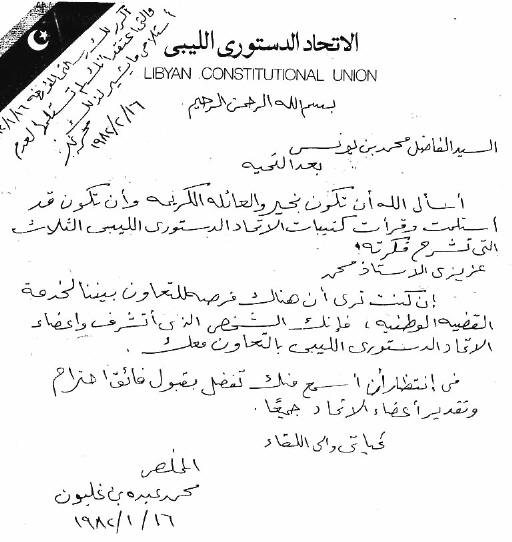 |
|
Translation of LCU letter to Mr Mohamed Ben-Younis
dated 16 January 1982
In the name of Allah, Most Merciful, Most Compassionate
The esteemed Mohamed Ben-Younis
Greetings
I
ask Allah that you and your noble family are all well. I hope that
you have received the Libyan Constitutional Union’s three booklets
which detail its idea.
Dear Ustad Mohamed,
If you think that there could be a chance to cooperate to serve the
Libyan national case, please know that you are the person whom I,
and members of the LCU, would be honoured to work with.
Waiting to hear from you, please accept the respect and appreciation
of all the LCU membership.
Till we meet, Regards
Sincerely
Mohamed Abdu Ben Ghalbon
16/01/1982
|
|
|
|
This part was published on
22 October 2006 the
following Libyan sites |
|
"Libya
Our Home" ,
"Libya Al-Mostakbal"
|
|
|
|
Top of
the Page Original Arabic
|
|
|
|
|
|
|
|
بسم
الله الرحمن الرحيم |
|
Part (9)
(First published in Arabic on
22nd September 2006)
[2] Announcing the Establishment of the
Libyan Constitutional
Union
Cont. Mohamed Ben-Younis
In
the previous part of this article I stopped at the invitation from
Mr. Yusuf
Al-Shaibani
to Mohamed Ben-Younis, Sami
El-Jerbi, Dr. Mohamed El-Gandooz
and myself which he extended at the end of our meeting at Mr. Ben-Younis’s
home.
I
considered Mr. Al-Shaibani’s invitation to me as an attempt to
continue the conversation about the Libyan Constitutional Union,
which was so rudely hijacked by Sami El-Jerbi’s irrelevant
provocation[1].
** * **
On the set date
I was warmly and courteously received by Mr. Yusuf Al-Shaibani. Mr.
Ben-Younis
was already there when I arrived but neither Mr. El-Jerbi nor Dr El-Gandooz
showed up. It occurred to me at the time that their absence was
possibly by instruction from
Mr. Ben-Younis,
who perhaps wanted to give our prospective meeting a better chance
of developing into a productive session.
** * **
I talked to
Mohamed Ben-Younis about the idea of the
Libyan Constitutional Union, and found him fully acquainted with all
its aspects through the LCU’s publications and our previous
meeting. He showed his abundant admiration for the idea, which he
considered to carry within it the solution to the Libyan ordeal. He
also expressed his sadness at the lack of support it received from
the significant and influential figures of the Libyan opposition.
After an
elaborate introduction in which he liberally praised the direction
of the
Libyan Constitutional Union, Mr. Ben-Younis said that he feared that
the opportunity to benefit from the LCU’s brilliant idea would be
squandered after certain sections of the Libyan opposition had
successfully disfigured its wider aim, of restoring constitutional
legitimacy to the country, and deformed it to a limited call for the
restoration of the monarchy.
Mr. Ben-Younis
further expressed his concerns that this false linkage, which had
effectively been achieved by those who were spreading it,
would
inevitably hamper the sincere and honourable efforts of the LCU and
would ultimately result in the total dissipation of such a wonderful
opportunity. For it was no secret that the monarchy was not among
proposed solutions on the agenda of the then current Libyan
opposition scene. Nor was it considered a favoured system of
government by anyone as a replacement to the dictatorship that is
ruling the country at the present time[2].
In other words,
the Libyan opposition was at that time[3]
not prepared to consider the struggle for restoring the monarchy,
and was in fact working towards forming a new political regime which
would be made up of ambitious personalities from within its ranks to
take control of the country in place of the wretched regime it aimed
to oust.
Mr.
Ben-Younis
deliberately continued his carefully prepared speech in a well
rehearsed pace to state that those “malicious lot” had in fact
succeeded in achieving their calculated goal of firmly tying the aim
of the LCU with the restoration of the monarchy. They,
consequently, deprived the LCU from a platform from which it could
continue working towards achieving its noble target. As a result
its idea of restoring constitutional legitimacy to Libya would be
left blowing in the wind.
He then told me
in his articulate manner that he had a proposition which contained
not only the way out of this difficult trap, and in accepting
it I would record for myself a grand deed of performing a
distinguished patriotic service to the national struggle, which
would benefit all parties involved.
I listened very
intently to his proposal. He went on to persuasively explain in
length the details of his offer, which could be summed up as a
patriotic deed. I would publicly announce that the true concept the
Libyan Constitutional Union revolved around the call for the return
of the monarchy to rule the country, rather than a call for the
restoration of the constitutional legitimacy. In other words
endorse the malicious rumours labelled against me.
Mr. Ben-Younis
continued by arguing that doing so was the only way to preserve the
opportunity of benefiting from the LCU’s original concept which has
suffered from the
saboteurs who succeeded in confining the LCU to an
organisation essentially aspiring to restore the monarchy.
He and other
good patriots would then, adopt the initial idea which calls for the
restoration of the constitutional legitimacy in a new formation and
attempt to rally everybody around it in order to achieve what is
good for the country.
** * **
At that moment
Mr.
Ben-Younis
became very small in my eyes for daring to try to sweet talk me into
adopting such a ridiculous proposition. To make sure that I
understood what he was trying to sell me, I enquired “do you want me
to publicly concede to the “malicious lot”, betray myself and my
collegues at the LCU who have joined this campaign under the
attraction of its original and clear idea and change course to
become a Royal party?”
I further added,
if I ever followed such a perverse approach, I would truly deserve
all the stigmas and rumours that have been levelled at me by those
antagonists, which they have thrown at me since the establishment of
the
Libyan Constitutional Union until this very day.
I told him that
I found myself forced to afford him valuable advice in return for
his deviant and eccentric proposal. I advised him to go ahead with
establishing –together with the patriotic colleagues he mentioned -
a body whose declared aim is the restoration of constitutional
legitimacy to the country. I elaborated by saying that he didn’t
need permission from me or anybody else in this regard. And that
there was nothing wrong with the existence of organisations that
work for similar agendas, as the success of one is a gain for all.
I further
clarified by saying that no one has a monopoly on this idea or any
idea in the field of national duty. And that I wish him and his
collegues well in their patriotic endeavour.
I continued by
asking him to leave the LCU alone and to never worry about its
competition. For –as he stated earlier- the “malicious lot” have
already taken care of it by trapping its idea and aspiration inside
a narrow political horizon, which –according to his own
calculations- would not take it further than a few steps on the road
of the national struggle before it collapses.
I concluded by
saying that I came to him with high hopes of gaining his support for
the direction of the Libyan Constitutional Union when it seemed to
me that he fathomed the intricacies of its idea in a fashion only
few others could match. And that I came with expectations that he
would join the LCU to add to it his considerable weight which was
rich in polished political experience, as well as his pool of
personal contacts with significant people. I asked him for the sake
of all this to wish us well in what we strife to achieve.
On that note our
discussion about the LCU came to an end, and we spent the rest of
the meeting chatting about current social affairs. I left shortly
afterward to return to my place of residence in Cairo.
** * **
I never saw
Mr.
Ben-Younis
again until the death of my father in late July of 1984 when he came
to my family’s house in Alexandria to offer his condolences to me
and my family.
During that
occasion
Mr.
Ben-Younis
tried to talk to me about his
National Covenant of Honour
project[4]
which he mentioned during our meeting in Manchester in the autumn of
1982, but was quick to realise that it was not an appropriate time
to discuss such matters.
It is relevant
to mention in this context that I received a letter in April 1984
inviting me to express my opinion on the
National Covenant of Honour
project which it enclosed a copy of. The letter was of unknown
origin and showed just
"The Preparatory Committee to
Draft a National Covenant of Honour” as signature without disclosing
any name of the said committees. Its sender never bothered to
mention his name or address in order to reply to. I had no other
alternative but to ignore that letter.
Three months
later I received a phone call on 23rd July 1984 from Mr.
Yusuf Al-Shaibani enquiring about my lack of response to the letter
he sent me! I explained to him that now after learning from
him that it was he who sent that letter I will respond to it in
writing.
The sudden death
of my father led to the delay in my response which was in the form
of a letter I addressed to
Mr.
Mohamed Ben-Younis
dated 20th September 1984 in which I expressed my views
on his proposed covenant of honour, which did not differ in the
slightest from the discussions we had in my house in Manchester in
1982 (copies of those letters are attached below).
To be
continued
Mohamed Ben Ghalbon
18th
October
2006
chairman@libyanconstitutionalunion.net
** * **
NOTICE
Publication of this series will stop during the month of Ramadan.
It will resume immediately after Eid El-Fitr
Warm greetings and Ramadan Mubarak to all.
[1]
See part 8 of this series under Mohamed Ben-Younis :
http://www.libya-almostakbal.com/MinbarAlkottab/October2006/mohamed_ben_ghalboon_lcu221006p8en.htm
[2]
It is perhaps worth mentioning that all this took place in December
1982.
[3]
In
the early years of the 1980’s
[4]
The
National Covenant of Honour was an idea by Mohamed Ben-Younis, in
which he tried to rally figures of the exiled Libyan opposition
around it.
----------------------------------------------------------------------
Appendix 1:
Copy of the
covering letter to Draft National Covenant of Honour
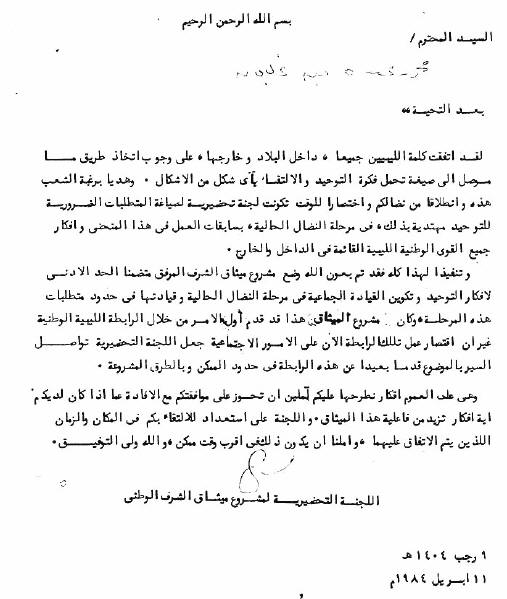
Translation of the covering letter to Draft a National Covenant
of Honour
The resolve of all
Libyans inside and outside the homeland has united on the necessity
to adopt a way that leads to a formula to meet and unite. Inspired
by the people’s said desire and prompted by your endeavour and in
order to save time, a “preparatory
committee for formulating the necessary requirement of unity” has
been established to formulate the necessary requirements needed for
unification. In the present stage of the struggle, the committee is
guided by
similar precedents in this field and by the thoughts of all Libyan
national forces active inside and outside the country.
Implementing all the
above and by the help of Allah, the enclosed draft “Covenant of
Honour”, was contrived. It contains the minimum of unifying ideas
to establish a collective leadership in the present stage of the
struggle and to guide it within the requirements of this stage.
This project was initially introduced through the National Libyan
League. However, the confinement of the activities of the said
League to social work only led the committee to progress in this
path away from the League, within what is possible and in the legal
ways.
In any case, they are
ideas we propose to you with the hope that they will gain your
approval, and to let us know if you have any thoughts that enhance
the effectiveness of this Covenant. The committee is prepared to
meet with you in an agreed time and place. We hope that this would
be at the earliest possible time. May God Grant success.
"The Preparatory Committee to
Draft a National Covenant of Honour”
9th Rajab 1404
11th April 1984
-----------------------------------------------------
Appendix 2:
Translation from Arabic of the Libyan Constitutional Union’s
Response To the
Draft National Covenant of Honour
20 September 1984
To: Mr. Mohammad Benyounis
Cairo - Egypt
Re: Draft National Covenant of Honour
When we met in Britain during 1982, I remember that one of the few
topics we discussed was your plan to proclaim a certain covenant or
Covenant; and we told you our opinion about it at the time. As we
parted, we were under the impression that you had been fully
convinced by the Libyan Constitutional Union's argument against the
idea.
Some two years later, however, we received a letter dated 11 April
1984, bearing an illegible signature on behalf of a "Preparatory
Committee to draft a National Covenant of Honour". To our
surprise, we discovered that the draft copy attached to it was
identical to the suggestion you had verbally put forth at our
previous meeting—a notion about which we had already expounded our
reservations for a number of obvious reasons.
The covering letter was just another invitation to consider the same
subject, albeit on a wider scale, whereas the enclosed text
contained absolutely nothing new. Furthermore, the letter made no
reference to the membership of the "Preparatory Committee" or the
date of its formation; nor was there any clue as to where it could
be contacted in case of reply or inquiry. And, since the Libyan
Constitutional Union had never been informed of the activities of
any such committee, we were actually at a loss to find out just how
it could be reached.
We could not very well rely on mere conjecture or guessing in an
important matter like this. Eventually, however, we received a
telephone call from Mr. Yousef Sheibani on 23 July 1984. He invited
us to attend a convention to be held in Cairo within a few days of
that date; and we also learned from him unofficially the names of
some members of the committee in question.
Now that we have ascertained that the draft Covenant presented
through the said preparatory committee is exactly the same as your
own original scheme, we find it necessary to make our comments known
once again as briefly as possible.
We must also be quite blunt in this matter, because we are all
dealing with a highly sensitive public issue which admits of no
private considerations or personal courtesies. Still, we do hope
that "difference of opinion will not sour friendship", as so
auspiciously put in the context of your proposal.
Perhaps the most objectionable aspect of this proposed “Covenant of
National Honour" is that it hardly conceives of the Libyan people
taking any active or effective part in changing the status quo. The
whole idea is based on the expectation of some kind-hearted,
military coup; and we are all supposed to just sit back and wait,
pledging right now that the moment it happens, we shall rush out to
shout our support for it with a deluge of "telegrams, letters and
memorandums" full of the national demands "listed in this Covenant
above all". Then the "gentlemen of the foreseen coup" would
graciously condescend to hand over the reins of power to a civilian
government in return for "membership of the constituent assembly" as
laid down in the Covenant.
Such, in a nutshell, is the overall picture which emerges from this
code of "honour". Regrettably, it depicts an outlook that is both
very naive and extremely depressing.
Looking back on all the atrocities suffered by our wretched people
in the wake of one destructive military coup, how on earth could the
"Libyan resistance forces" be invited to come together for the first
time merely to pledge their recognition in advance of any fresh coup
that might be tempted to consider some beggarly petition for the
equitable rights of the people? The entire history of military
coups, including the infernal one that dominates our nation today,
clearly indicates that (no matter how well-intentioned, some
individuals might be at the outset) the ruling junta would
invariably turn into an absolute, repressive authority that would
not hesitate to back out of whatever promises or commitments made
earlier on.
Indeed, the arrogance of easy power could become so strong that some
coup leaders might even make the absurd boast that if it were not
for them, the nation would never have been able to bring about
anything like their so-called revolution, as is the case in our own
country.
Now then, is it not utterly disgraceful that the Libyan opposition
"forces" should be called upon to place their future plans totally
at the risk of once more exposing all Libyans to such humiliation?
This proposed Covenant of yours is asking us all to “commit
ourselves to definite things and goals in the current phase of
National struggle. After the expected coup d'état has been carried
out by the “forces of good” in our armed forces.....” Are we to
understand from this prophecy that the “preparatory committee”
itself has made preparations for an impending coup? Otherwise, how
would you know that any potential coup would be staged by none but
the “forces of good”? And what if they were to be outstripped by
some other forces of “less” good?
A quick glance at the record of contemporary coups -of which the
coup of our own national army is a prominent example -should be
enough to show us that most 'forces of good' are either eliminated
by violent means once they have played out their role in
consolidating the junta's authority; or they too, may turn willingly
or unwillingly into mere tools to serve the new oppressive regime.
This, of course, does not mean that the Libyan Armed Forces have
ever been short of excellent patriots who share their people's pains
and aspirations.
Such men will inevitably turn against the regime sooner or later.
They probably feel the brunt of its oppression much more acutely
than a lot of people may think who are out of touch with the
realities of constant confrontation and daily conflict. Therefore,
a sudden military coup is always a distinct possibility; and,
despite all adverse conditions, the civilian population may very
well be surprised by such an eventuality at any time.
But the desired fundamental change must not take place in isolation
from the indomitable forces of the people as a whole. Otherwise,
the nation may only get out of one ordeal to be plunged into another
vicious circle of a similar chain of events.
In other words, if the armed forces were to take the initiative in
bringing down the present dictatorship out of a sense of national
responsibility to fulfill the people's expectations, they would be
doing nothing more than their normal duty. There is no reason why
the military should then be idolized as heroic saviours to such an
extent that any special or exceptional privileges would have to be
conceded to them in sharp contrast with the lot of ordinary
citizens—as your proposed "Code of Honour" seems to suggest.
After all, the armed forces' contribution to any democratic change
would be a great service to their benefit as well. It would be an
opportunity to redeem their sullied military honour and wipe off the
shame inflicted upon them by the rule of armed gangsters over the
past fifteen years.
Besides, those who are solely motivated by the dictates of honour do
not usually expect to be rewarded for the performance of patriotic
duties.
The second objective in the proposed "Covenant of Honour" provides
for the election of a constituent assembly during a transition
period. At the end of the plan, however, we find another paragraph
which guarantees to the "men of the anticipated coup" that they
themselves would become members of the constituent assembly "by
virtue of their leadership of the military movement". How can such
an explicit assurance be reconciled with any call for free
elections, unless we actually intend to manipulate our future
electoral system for the sake of this "prospective coup"?
We can understand, for instance, how the whole country has been
forced, to abandon its Constitution and all democratic institutions
since the people suddenly found themselves in the face of an
overpowering military regime which usurped their rights at
gun-point. But to give up any democratic right or principle so
voluntarily (even before it has been regained by the people) is a
very strange requirement indeed. We shall leave it here without
further comment.
Let us now move on to the speech delivered by the preparatory
committee at the conference held in Cairo on 4th August
1984. It contends that “those who call themselves independent.....
often have no objection to flirting with the gangs; and unless this
proposed national Covenant of honour is adopted, such flirtation and
rapprochement will develop even further; and we shall have given
them the chance do so”.
We take it that the above passages refer to those émigrés who remain
basically unattached to any of the existing opposition factions. In
this sense, we see no justification for criticising all
“independents” en masse. As a matter of fact, such a strong attack
on these people is rather illusive and even inconsistent with the
very concept of political democracy.
The truth is that the Libyans now living abroad do not have to
“flirt” or come to terms with the regime in any way, unless they are
actually among its puppets or merely trying not to antagonize it.
On the other hand, those who do have certain dealings with the
regime -whether directly or indirectly- are not in need of
encouragement from anyone; nor could, they be dissuaded by any "code
of honour", since they do not seem to have any sense of honour in
the first place. Their false pretensions to patriotic fervour cannot
fool all the people all the time. They need not even be considered
in the context of codes of honour.
Nevertheless, we believe that earnest patriotic endeavour could not
and should not be monopolised, or controlled, by any individual or
group. All sincere Libyans are fully entitled as a matter of course
to choose whatever method they deem fit to oppose the dictatorship
that dominates their country and the fate of their nation. It is by
no means discreditable for any person to decide not to belong to any
particular one of the dissident organisnations now in existence.
The slogan "No independents henceforth" (as verbalised in the speech
by the committee) looks like another side of the same familiar coin.
It is essentially no different from the declaration of "no political
parties after today" which is a great favourite of military regimes
in general. What the Libyan of today needs most of all is the
freedom of original and independent thinking as an indispensable
democratic weapon to fight against fascism and crack the hard shells
of monochrome thought, autocratic rule and arbitrary opinion.
In conclusion, we wish to go back once more to the text of your
proposed Covenant; for it harps on the theme of a "prospective coup"
in a decidedly worrying tone. The standpoint of the Libyan
Constitutional Union has been made abundantly clear in warning
against the dangers of classic military coups. They usually have
the effect of a temporary drug, distracting the people from their
real aspirations in a sudden exuberance of joy for getting rid of
some former oppression. But, sure enough, they soon turn against
the very same people they are supposed to have delivered from all
evil.
We, Libyans, had better not gamble on any "expected" or unexpected
coup d'état.
Let us, instead, remember one recent event in the history of our
Arab region. Only 20 years ago, the unarmed Sudanese people managed
to overthrow a fierce military government without having recourse to
any "Covenant" of this sort.
We certainly do not think that our own people will ever stand in
need of publicly documenting their “national honour” in readiness
for a coup d'état.
Mohamed A. Ben Ghalbon
Chairman
Libyan Constitutional Union
Manchester / UK
Please click here to view the
original document in Arabic
|
|
|
|
This part was published on October 2006 the
following Libyan sites |
|
"Libya
Our Home" ,
"Libya Al-Mostakbal"
|
|
|
|
Top of
the Page Original Arabic
|
|
|
|
|
|
|
|
|
|
بسم
الله الرحمن الرحيم |
|
Part (10)
(First published in Arabic on
27th October 2006)
[2] Announcing the Establishment of the
Libyan Constitutional
Union
Haj Ghaith
Saif Al-Nasr
The good name and reputation of the
Saif Al-Nasr family in
Libya make any introduction to this family and its members
redundant. The first generation of this family bravely performed the
honourable duty of defending the homeland against foreign occupation
and repeatedly sacrificed their lives and possessions. They fought
along with their other brothers under the banner of the Senussi
movement.
Following independence, the Libyan state acknowledged the loyalty
and steadfastness of this family of freedom fighters by conferring
on its second generation high honorary and political positions. Haj
Ghaith Saif Al-Nasr was among the members of this family who assumed
these high positions. He was appointed as the Wali of the province
of Fezzan and later as its governor after the abolition of the
federal system of government in 1963. Further, Haj Ghaith had been
appointed as the Libyan ambassador to Chad and remained in this
position until the usurping of power by the military in their coup
d’etat of 1st September 1969.
Another member of the family, Mr. Saif Al-Nasr Abdul-Jalil Saif Al-Nasr
was appointed a minister of defence in various successive
governments.
** * **
I spent most of the month of July and the last days of June 1982 in
the Moroccan capital, Rabat. This period coincided with the holy
month of Ramadan. I spent most of the fasting month and Eid El-Fitr
in one of the historical city’s hotels with the exception of a few
days when I made a quick visit back to Britain during which I met Mr
Abdulhamid Albakoush who visited me at my home in Manchester.
[1]
The star of the National Front for the Salvation of Libya (NFSL) at
that time was rising very fast and Rabat was one of the main centres
of this organisation’s growing activities. No other group or
organisation could attain this level of activity.
It was not difficult to notice the presence of the numerous leaders
and members of NFSL in the Moroccan capital. Moreover, it was
equally easy for the organisers of the NFSL to obtain personal
information about Libyans in that country, be they residents or
visitors.
** * **
One day I received a phone call from Haj
Ghaith Saif Al-Nasr whom I had neither met nor known
beforehand. He expressed his desire to meet me in the hotel where I
was staying
[2].
As well as being one of the notable members of the Saif Al-Nasr
family, Haj Ghaith was also one of the founders and the prominent
leaders of the NFSL, and its deputy general secretary.
Haj Ghaith arrived at the hotel at the set time, soon after Asr
Prayers. I received him in the entrance hall and we moved to an
empty and quiet corner in the hotel foyer to discuss the subject for
which my guest took the trouble of coming to visit me on that
memorable day.
I immediately noticed the pragmatic manner that my honourable guest
was observing in dealing with me. He did not waste his time in the
customary Libyan protocols of courtesies, civilities or the lengthy
conviviality. Haj Ghaith went straight to the subject that he came
to address without any delay or hesitation.
Haj Ghaith told me in an apparent temper and disquiet
[3] that he could neither understand
nor appreciate the reasoning behind my adopting a diverse approach
to the one agreed upon by everybody else. For, he continued, my
founding of the Libyan Constitutional Union was, in his opinion,
disbanding the efforts and dispersing the potential power to change.
Furthermore, he continued, I should join this mass movement as
represented by the NFSL which was supported by the big powers and
enjoyed the help of the influential countries in the Arab World.
Moreover, he added, the NFSL was not only supported by most of the
Libyan people but also by rich and politically influential Libyan
personalities. Therefore, my insistence on being outside this
social accord, cohesiveness and collaboration, which had been
achieved by the NFSL through its structure as an opposition
organisation, would make me out of step with everybody else.
In reference to
the call of the LCU for unity around the person of the King and the
renewal of allegiance to him, Haj Ghaith
Saif Al-Nasr said, that they, the members of the Saif Al-Nasr
family, were Senussis by nature and that the Senussi ethos ran in
their blood and if it had happened that a vein under the skin of any
of them was found without this type of blood then it would be cut
off. He continued, that they did not accept, under any
circumstances, anybody to lecture them on their family’s loyalty to
the Senussi movement in general and to King Idris in particular.
Haj Ghaith continued by saying that, in this regard, there was a
firm intention to honour King Idris after the liberation of Libya
from the oppressive Qaddafi regime. Therefore, there was no need to
unite around him, for this would not make any difference.
I listened to my visitor’s speech throughout, which was saturated
with severe criticism of my stance and
perspective
that was different to that of the NFSL system of ideas and
organisational approach. This lasted all the time between his
arrival just after Asr prayers till just before Maghrib (sunset).
** * **
After he had finished all he had to say and was about to leave I
said to Haj Ghaith Saif Al-Nasr, that I had , in summary, four
points I wanted to tell him very quickly as a reply to his previous
address:
Firstly, honouring the King, in essence, should not
take place after the liberation of
Libya with ceremonial speeches and a memorial medal. True honouring,
for those who understand its meaning, should take place during his
harsh exile and bitter isolation, alone and away from home through
restoring the esteem which is due to him and showing respect and
appreciation by rallying around his person.
Secondly, in the absence of undertaking such a step, his reference
to the non-acceptance of the Saif Al-Nasr family of anybody to
discuss their loyalty to the Senussi movement in general and King
Idris in particular by describing this loyalty with the blood
running in their veins, remains mere rhetoric. The extent of
somebody’s loyalty could only be measured according to their actions
during the period of history in which they live. And that is what is
consequential in this regard. However, one could not depend on
stances of the forebears in previous history to absolve the
individuals of their current duties and present responsibilities in
proving and showing the extent of loyalty which they claimed they
had proved and were consequently proud of.
What is meant here is that the judgement and the evaluation of
individuals vis-à-vis their moral and ethical stances during
successive historical periods could only be made within the context
of their contemporary events and political circumstances.
The previous historical periods to these events and circumstances
have no bearing on these judgements and evaluations.
Therefore, for the description that he mentioned- concerning
the flow of the Senussi blood in the veins of the members of the
Saif Al-Nasr family to be credible he would have to go to King Idris
and renew his allegiance to him. This renewal of allegiance was due
to King Idris for he was the representative of the constitutional
legitimacy as the entire Libyan nation honoured him to be.
Furthermore, the above mentioned metaphor had been adopted from a
saying by his uncle Mohammad Saif Al-Nasr, who said when he was
oppressively and wrongly incarcerated by the dictatorial regime, “If
I had a vein not pulsating with Senussi ethos I would slash it.” He
meant every word he said. Moreover, he restricted what he said to
himself and did not include any other member of the Saif Al-Nasr
family. He - may Allah bestow His mercy on him and make paradise his
abode- never retracted from this belief in spite of the pressures
and the bargaining of his jailers to set him free. He preferred
death in prison to renouncing his principles. He was true to his
principles because of his determination, his strong faith, his
courage, his fortitude and firmness in what is right.
Thirdly, I added that he might not agree with me on this at this
moment in time due to our diverging points of view; in spite of all
the huge resources and the immense support that the NFSL has
received to liberate the country from Gaddafi’s rule, the whole
enterprise is doomed to inevitable failure. The dream of toppling
Gaddafi’s regime would not be realised through this specific means.
I told him not to be fooled by the support from the great powers for
the NFSL at that present time and bear in mind, with certainty, that
these countries had their own plans, aims and interests without any
consideration for the interests of the Libyan people and their
bitter suffering under the rule of this corrupt regime. I added that
time would show how true and accurate this analysis would be.
I continued to say if this proves to be true – as I was sure it was
– he was more than welcome to join the Libyan Constitutional Union.
For the LCU is suited for members of the illustrious Saif Al-Nasr
family to be at the forefront of it. The bright history they
attained by way of their fighting alongside the Senussi movement and
their loyalty to it made them most eligible to assume leadership
positions in the Libyan Constitutional Union
[4].
The final point can be deduced from a simple question of two parts:
Why do some of you go to so much trouble in your attempts to
criticise my political orientation and to persuade me to abandon it?
Is it really the case that the major obstacle to your efforts for
the national cause lies in my political orientation?
The answer to this question is in what they said and in their
criticism of me. For these critics said on more than one occasion
that their approach to the struggle would not face failure and its
success would be certain. The elements of the certainty of this
success come from the absolute support their idea gets from the
international, Arab and regional powers. Add to this, success
according to these critics, could also be attributed to the power of
money, men and equipment that their ideas, methods and orientation
of the struggle attracted from the beginning.
Therefore, no impediment existed for their achieving the success
that they were aspiring to under any consideration and my political
orientation would not change this fact at all. So I requested they
leave me alone as there would be no fear that I or my orientation
would have any detrimental effect on the realisation of their goals.
** * **
And so ended my encounter with Haj Ghaith Saif Al-Nasr, who did not
like my reply as evidenced by the angry expression on his face.
Maghrib was about to arrive so I insisted that he accepted my
invitation to break our fast together in the restaurant at the hotel
where I was staying.
However, he refused my invitation and muttered as he turned away
towards the door of the hotel waving his hand that his Iftar
(breaking of his fast) was awaiting him at his house.
As I said earlier, I spent most of the month of Ramadan and Eid El-fitr
in the Moroccan capital where many of the members of the NFSL had
their homes or were staying in its hotels. I knew some of these
members personally; however, I did not see any of them.
My only contact with any of the Libyans in that country at that time
was with Mr Mohammad Othman Essaid who from time to time would
invite me to break the fast with him at his home.
** * **
Mr. Saif Al-Nasr Abduljalil Saif Al-Nasr
It was only natural that Mr. Saif Al-Nasr Abduljalil Saif Al-Nasr be
among the list of Libyan dignitaries (of the wise and influential
category) whom the LCU approached to try to attain support of its
patriotic mission. He was of a distinguished status in the Libyan
society both politically and socially.
I had a warm and cordial relationship with Mr. Saif Al-Nasr
Abduljalil which dated back a few years. This made it easy to
initially contact him and thereafter set up a meeting in the winter
of 1982. He welcomed me very warmly in his flat in Cairo where he
lived permanently. As we entered the sitting room I was attracted
by a very impressive portrait of His Majesty King Idris which was
hung on the wall. It was a very beautiful photograph mounted on a
magnificent frame, which showed King Idris in his full glory.
** * **
After chatting briefly about past memories and the present ordeal
and tribulations of the homeland under the repressive and corrupt
regime, we began discussing the idea of the LCU. I was anxious to
assess Saif Al-Nasr’s view and stand on the establishment of the LCU
and its proposed direction.
Saif Al-Nasr’s full knowledge of the details of the LCU’s Idea,
motives and aims spared me the exertion of explaining and
elaborating, for he had had a good look at all the publications by
the LCU prior to that meeting [5].
I asked Saif Al-Nasr about his view and standpoint on the LCU’s
idea, which called for the consolidation around the King as a first
step towards restoring to Libya the usurped constitutional
legitimacy. With King Idris as the focal point of this
constitutional legitimacy, as he was the undisputed choice of the
entire nation which elected him as its leader and national symbol of
this constitutional legitimacy in accordance with the nation’s
constitution which it formulated on the eve of independence.
I further clarified by expressing my sincere wish that he would take
the lead in realizing the objective of rallying around the king,
which would go a long way to supporting the effort along the road of
the task of restoring the country’s lost constitutional legitimacy.
At that point Saif Al-Nasr objected to my appeal to him to rally
around the King. He saw that as an insult to him and to members of
his family who never ceased to be loyal and were whole heartedly
devoted to the Senussi movement since its emergence in the late 18th
century.
He added that loyalty to King Idris was a duty and an obligation on
every single member of the Saif Al-Nasr family and that they do not
need anybody to persuade them to illustrate or prove it.
He passionately went on, in a show of his devotion and loyalty to
King Idris, by saying that the necks of the Saif Al-Nasr’s family
never obeyed or yielded to anybody but this man, placing the edge of
his palm on the back of his neck while pointing to the photo of King
Idris with his other hand.
I immediately conceded to his objection which was consistent with my
own firm knowledge of his family’s long and honourable history in
serving the Senussi movement and devotion to its masters. I further
said to him that we were both in agreement in this regard and
therefore there should be no problem which would prevent him from
using his considerable prestige and influence to gather a group of
likewise Libyan notables from émigrés in Egypt and other countries,
and lead them to the King to offer their support to him and renew
their allegiance to his Majesty.
I further clarified that what was consequential here was the level
of success achieved in serving the national cause, and that did not
mean having a monopoly on the means that lead to achieving it.
In other words, the LCU does not demand from others to come under
its wing in order to achieve the common national interest, but
strongly promotes a variety of channels that will eventually lead to
realising the goals aspired to by the Libyan people.
That is to say that Mr. Saif Al-Nasr did not need the LCU at all to
express his loyalty and support to the King. The field was open to
him and to others to rectify the inverted image of our country’s
case, which would never be rectified without rallying around the
King and consolidating behind him as a first step towards retrieving
our country’s plundered constitutional legitimacy.
I went a step further in my attempt to secure the goal of my visit
by offering to arrange a meeting for Mr. Saif Al-Nasr with the King
where he could visit his Majesty accompanied by a group of Libyan
dignitaries. He thanked me profusely and told me that he did not
need my intercession, for his path to visiting the King is wide
open.
Hence, I parted company with Saif Al-Nasr fully content that I would
soon hear that he had paid His Majesty a visit accompanied by a
number of prominent Libyans to declare their loyalty and support.
Instead, I heard not long afterwards, that he had joined Mr.
Abdulhamedd Al-Bakoosh’s organisation. The rest is well known
history. King Idris passed away without this visit ever
materialising.
To be continued
Mohamed Ben Ghalbon
17th November 2006
chairman@libyanconstitutionalunion.net
(Many
thanks to Mustafa for translating this document from Arabic)
_________________________________________
[1] Details of this meeting with Mr. Abdulhamedd Al-Bakoosh are in
part four of this series.
[2] When Mr. Gaith Saif Al-Nasr told me on the phone he wanted to
see me I thought that he wanted to invite me to have “Iftar” at his
house.
[3] I thought that Haj. Gaith Saif Al-Nasr was talking to me in this
temper and rough pitch because he either was under the influence of
the fast in that hot summer day which often makes people tense and
irritable; or that he was a naturally bad tempered person and that
was how he usually communicated with people. I found out later that
I was wrong on both accounts.
[4] All my expectations in this regard have unfortunately turned out
to be true.
[5] As I did with other Libyan notables, I sent by post copies of
the LCU’s publications to Mr. Saif Al-Nasr Abduljalil Saif Al-Nasr
followed by a personal letter. In that letter (copy enclosed below)
I asked him to forward copies of the said publications to Haj.
Ghaith whose address I couldn’t attain. I was eager for him to be
familiar with the call and aims of the LCU, in the hope that we
could gain his sympathy and support. I wrongly referred to Haj
Ghaith in that as Saif Al-Nasr’s brother. When I met the latter he
corrected me that Ghaith is in fact his nephew not his brother
------------------------------------------------
Copy of the LCU’s letter to Mr.Saif Al-Nasr Abdul-Jalil dated 5th
February 1982
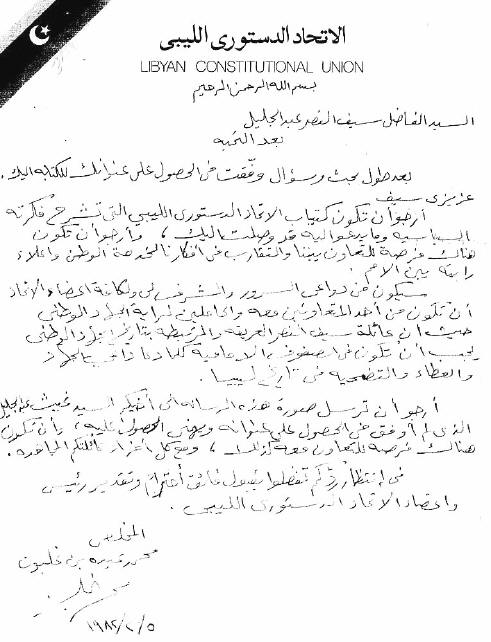
Translation of the LCU’s letter to Mr. Saif Al-Nasr Abdul-Jalil
dated 5th February 1982
In the Name of Allah, the Compassionate, the Merciful
The esteemed Mr. Saif Al-Nasr Abdul-Jalil
Greetings
Following a long search and enquiries I managed to obtain your
address to write to you.
Dear Saif,
I hope that you received the LCU’s booklets, which detailed its aims
and political orientation. I also hope that there will be an
opportunity of cooperation between us, and convergence of our ideas
to serve our country and fly its flag amongst nations.
I would be delighted and honoured, and so would all members of the
Libyan Constitutional Union, if you would cooperate with it to raise
the banner of the national struggle together. For the deep-rooted
Saif Al-Nasr family, which is synonymous in Libyan history with
defending the country and fighting for the homeland, should be in
the forefront every time Libya calls for giving and sacrifice.
I hope that you would also pass a copy of this letter to your
brother Mr. Ghaith Abdul-Jalil, whose address I am still trying to
obtain. And that there would be a chance of cooperation with him
too, as well as all of your noble family.
Waiting for your reply, please accept the respect and appreciation
of the chairman and members of the Libyan Constitutional Union.
Sincerely
Mohamed Abdu Ben Ghalbon
5/2/1982
|
|
This part was published on
18 November 2006 in the
following Libyan sites |
|
"Libya
Our Home" ,
"Libya Al-Mostakbal"
|
|
|
|
Top of
the Page Original Arabic
|
|
|
|
|
|
|
|
|
|
|
|
بسم
الله الرحمن الرحيم
Part (11)
(First published in Arabic
on 12th November 2006)
[2] Announcing the Establishment of the
Libyan Constitutional Union
Mohammad Ali Arebi
Mohammad Ali
Arebi belongs to one of the prominent Berber families and is a
distinguished person amongst his people. He is also a wealthy
businessman well known in the western part of Libya.
Mr. Arebi was
impressed by the idea of the Libyan Constitutional Union and its
proposed solution having read its publications. He contacted me to
arrange a meeting in Rabat where he was permanently domiciled and
where he enjoyed a prominent status and high level contacts inside
its political circles.
From the first
meeting, which took place in 1982, we quickly developed a sort of
rapport, where Mr.Arebi told me about the business relationship he
had with my late father during the time of the Italian occupation of
Libya. He also told me about his close friendship with my late
uncle Mahmood Darbi in Tripoli where he lived until he left Libya.
** * **
I was quite
pleased and content when Mr. Arebi voiced his admiration of the
Libyan Constitutional Union and me personally. He promised to aid
and support the LCU and provide it with everything in his power to
help it achieve its goals.
I thought that I
had hit the jackpot in the initial quest to secure the needed
support for the activities of the LCU.
** * **
Although Mr.
Mohammad Ali Arebi fully grasped the essence upon which the idea of
the LCU was built, I felt it was necessary to emphasise to him the
necessity and importance of the support of the Berbers to any
endeavour that has as its core the restoration of the constitutional
legitimacy to the country.
I further
explained that the reason which implores the Berbers, in particular,
to support and assist the call for the return of the constitutional
legitimacy to the homeland lies within the text of the nation’s
constitution.
In more specific
terms, it was right and absolutely essential that the entire Libyan
people -with all its various factions- hold on to the nation’s
constitution and fight for its re-establishment, for it vigorously
and unconditionally preserved the privileges of all citizens to
practice their civil and political rights equally without any ethnic
or sectarian discrimination.
The Libyan
constitution provided the legal framework for the nation’s
minorities
[1]
to preserve their ethnicity and freely practice their religious
rites. It served as the supreme guarantee that all Libyan citizens
were equal and shared the same rights and duties regardless of their
ethnicity or religion.
** * **
I
reminded Mr Arebi that those who founded the Libyan state on the eve
of independence were very conscious of the need to accommodate the
various compositions that constituted the Libyan nation that they
decided not to add the word “Arabic” to the country’s name. The
name of the new born state became the “United Kingdom of Libya”.
Then after the Federal System was abolished in 1963 the country’s
name became the “Kingdom of Libya”. That was done at a heavy price
as some
[2]
were mounting pressure on the rulers of the young country to add the
title “Arabic” to its name. To do so the decision makers of that
time felt would be unjust to the Libyan minorities who did not
descend from Arabic ancestries.
Although the
founders of the modern Libyan state were very careful to establish
all the necessary guarantees that would insure equality of all
citizens before the law, and in-spite of their commendable efforts
to enable the minorities within the Libyan society to practice their
rights unhindered by bigotry. We find that they naively overlooked
an issue that would later have a detrimental effect on their newly
established country.
The issue was
the tribal composition of the Libyan society and the dual loyalty
that represents the crux of the tribe. More often than not loyalty
to the tribe would prevail over the loyalty to the state. The abuse
of power by certain heads of tribes in favouring their tribes over
the interest of the state and the rest of its nationals had
seriously damaging consequences, which were ultimately utilised by
the military junta as a pretext for their wretched Military coup
d’état.
This delicate
but extremely important topic requires more detailed analysis and
can not be discussed in few lines here. In order not to disperse the
reader’s attention I therefore consider it appropriate to come back
to it at the end of this chapter to examine it in the detail it
merits.
** * **
To return to our
subject, Mr. Arebi agreed that the Libyan constitution was
absolutely fair and just in organising the running of the Libyan
state. He also testified that those who drafted the constitution
had fully noted and respected the rights of the minorities, in
direct contrast to the present military coup d'état [3]. He told me
that from that moment on he would appoint himself as my envoy to
approach –on my behalf – our Berber brothers in order to urge them
to support and assist the LCU until it realises its aspired goals.
My friendship
with Mohammad Ali Arebi grew stronger by the day. We had regular
social meetings and there was nothing on the horizon to predict any
change to that.
However, a new
and unexpected development took place. Not long after my newly
growing friendship with Mr. Arebi, he disclosed to me that some
officials from the US government wished to meet me to talk about the
LCU and its orientation and future plans.
Mr. Arebi was
surprised when I immediately accepted the offer without hesitation.
My guess was that he probably thought that he would have to engage
in a lengthy debate with me to persuade me to go ahead with his
offer and came prepared with all the necessary arguments.
He did not
appreciate that I considered gaining the international public
opinion, at the level of the governments of the major countries that
influence the direction of the global political system, was another
essential step to the success of the arduous task of liberating
Libya from the grip of the military coup and restoring
constitutional legitimacy to the homeland.
If we concede
that the importance of the above demand places it on top of the list
of priorities of the designed plan to realise the aspired goals,
then gaining the USA – the most influential power in the world – on
the side of the Libyan people’s legitimate right to regain its
constitutional legitimacy, placed the USA on top of the list of
countries that should be addressed to achieve this goal.
Mr Arebi wasn’t
aware of the greater vision of the LCU which covered all the
essential and important focal points that influence the fulfilment
of its goals.
** * **
As such, Mr.
Arebi arranged the meeting with US Government officials, which
eventually arrived at a dead end. I have previously published
lengthy details of these meetings in the London based Arabic daily
“Al-Hayat”. In order not to depart from our main topic I enclose a
link to this article [4].
Sadly, Mr.
Mohamed Ali Arebi cut off all his contacts with me following the
collapse of my talks with the American officials. He repeatedly
avoided talking to me and evaded my attempts to contact him.
With the
termination of that short lived friendship upon which I had very
high hopes, all of Mr. Arebi’s promises to secure the support of the
Berber people to the LCU’s cause were blown away in the wind, as
were his promises to financially support the activities of the
Libyan Constitutional Union.
** * **
The effect of the abuse of tribal power in Libyan political life :
In what follows I will introduce a full explanation to the
background of the influence of the tribal mindset and how this
reflects on the participation of its members in the political
process within the state that accommodates them and their tribe.
The need to explain this background is so essential that it can not
be ignored or overlooked; it will enable the reader to make sense of
the motives behind the stances taken by some of the personalities
mentioned in this documentary article.
I will introduce an explanation of the composition of the tribal
structure, the principles that govern it, and the relation between
its members and the state they belong to. I will give examples from
contemporary events, wherever the need arises, in the hope that this
will prove the accuracy of this analysis.
** * **
The Tribe and the principles that Govern it :
The tribe is considered one of the primary organised groupings known
in the whole history of mankind. Over all his consecutive epochs
man never knew a social form of clannishness that accommodated him
and others of his race within its bounds as the tribal structure.
The tribe was born out of man’s persistent need for it. Man’s
struggle for survival with rivals from his race forced him to
consolidate his position with his kindred
Human history witnessed the first elements of groups of people
sharing the same blood as they attempted to create associated groups
that have common aims and benefits. Groups of blood relations would
fight together to defend their interests against rival groupings.
Throughout history clans evolved into tribes to become, with the
passage of time, the nucleus and essential basis of the
nationalistic structure of the various modern human societies.
Not a single part of the world throughout human history was an
exception to the existence of the tribal system within it. All
human societies have known and experienced the tribal structure
under the necessity for power to preserve its common interests with
its blood kin.
However, in later centuries of the human voyage, and as a response
to human development and man’s incessant aspiration to improve his
living conditions and standards, the tribal structure began to
disintegrate in many societies across the globe to give way to
entities of civil and urban societies which co-existed within one
state under the umbrella of modern and comprehensive laws which
regulated the relations between these individuals and guaranteed the
rights of all its citizens without prejudice or discrimination.
However, some tribal structures still exist, especially in the Arab
world where they continue to maintain this primitive mould which
shaped it thousands of years ago. These structures defied the need
to integrate or dissolve into the state that accommodated them
within the general framework of society as a whole. It favoured its
instinctive narrow outlook of protecting its own interest more than
its loyalty and belonging to the general society of the state
There are principles and codes of conduct that govern the
infrastructure of the tribe in its primitive form, which in turn
control its behaviour. These could be summarised as follows:
** * **
When these principles are implemented on the ground inside the
comprehensive structure of the state, it would - at some point -
inevitably clash with the laws that synchronize the relations
between its citizens.
The political leaders of the monarchist era were oblivious to the
dangers of these fundamental factors. They failed to embark on a
serious process to politicise the tribe and modernise it so that it
could amalgamate its aims within the framework of the general
interest of the state that accommodates it along with other
different groups and denominations, in coherence and harmony which
would achieve the common benefit to society as a whole with its
various members, clans, tribes and ethnic and religious minorities.
Thus enabling everybody to endeavour to achieve the best for the
country that they all belong to rather than to achieve the interests
of their particular tribe or ethnic minority at the expense of the
prime aim of the
welfare
of all citizens of that country as a whole.
Instead, they left the tribal structure unchecked to gain control
over some aspects of the political decision making in the newly born
state.
The gravity of this inherited error led to
intensifying the gulf
that existed between the citizens and the state on the one hand, and
on the other, turned some powerful tribes into power centers that
defied the authority of the state and would consequently defeat it
whenever they clashed. We could perhaps find this clear in the
following two brief examples:
-
One tribe forced out one of its members from a court of law while
he was being tried on charges of issuing orders to fire live
ammunition on protesting students during the well-known student
events of January 1964, which led to several fatalities.
-
2. Massive
crowds from certain tribes picketed in front of the royal court to
prevent the King from resigning and forced him to withdraw his
proposal to change the form of rule from Monarchist to Republican
during the sixties.
** * **
Accordingly, one could easily attribute most of the monarchy’s
shortcomings to the tribal domination over the reigns of power.
However, this would be only a fraction of the truth. Looking at the
wider picture, the tribal domination over the reigns of power during
the monarchy had another reason behind it, which was totally
overlooked by all. The heart of the problem lies in the tribe’s
primitive structure, which is built around ideals that do not meet
the terms of the spirit of the time in which the modern state was
created.
In other words, those tenets, which stem from pure clannishness, are
in fact what were responsible for the insolence of some of the
tribes’ idiosyncratic behaviour. Some tribes would refuse to abide
by the laws of the state and would continually defy its dictates
which regulate the relations of its people whom the tribe is merely
a segment of.
** * **
Therefore, politicising the tribal structure through education of its members and cultivating amongst them the concept of
loyalty to the homeland as an indivisible integrated entity was a
vital necessity in a society where some of its sections were still
guided by a tribal mentality fit for dwellers of the first
millennium. The outcome would be eliminating their chauvinism and
bias towards their tribes at the expense of the rights and interests
of the rest of society. The hope would also be that it would
generate and deepen in them a sense of belonging to the homeland as
a single unit rather than to the clan, tribe or ethnic minority.
This would lead to accomplishing the sovereignty of the state over
all its various compositions, and consequently to the equality of
all its citizens before its law regardless of the diversity of their
tribal origin or ethnicity.
However, the reality, as we all know it, was during the monarchy era
tribal bigotry dominated certain aspects of the political decision
making process. This bred a chronic gulf in the relation between
the ordinary citizen and the state. Ultimately the negative
consequences of this led to the failure of the state to dictate its
authority to efficiently enforce law and order.
Later on, the illegitimate rule of the military coup of September
1969 utilised this very same tribal bigotry to achieve its malignant
designs.
Nevertheless, it has to be noted that the tribe is considered an
important establishment within the fibre of Libyan society. Tribes
form the major component the country’s population.
It is therefore, absolutely imperative that it is developed through
acculturation and
politicising of its members to give precedence to the belonging and
loyalty to the homeland ahead of loyalty and belonging to the tribe,
to eliminate the dual loyalty which most individuals of the tribal
structure suffer from.
** * **
Tribal bigotry could be the motive behind Haj Mohammad El-Saifaat’s
un-compromising stance towards the LCU. Not only did it stop him
from supporting and aiding it, but it made him an active enemy who
fought and resisted it from the day it was announced. This was due
to the fact that the LCU’s initiative came from a person from
amongst the urban populace, and did not originate from within the
tribal structure which had been at the forefront of the struggle
against foreign occupation of the country, and consequently, later
ruled the country, in the post-independence period, by rallying
around the person of the King.
In order to give credence to this assertion, I will narrate, in what
follows, certain relevant incidents and events.
** * **
Former Prime minister Hussein Maziq (may Allah bestow His mercy on
him), who was the head of the Barassa tribe and one of the main
pillars of the monarchy regime had come to know about Haj Mohammad
El-Saifat’s hostile stance and activities towards the LCU. This
enmity puzzled Mr. Maziq, for he knew that the main orientation of
the LCU was based on the call for the return of constitutional
legitimacy to the country through its unity around its
representative King Idris Sennusi. He was bewildered because Haj
Mohammad El-Saifat was considered one of the most prominent
personalities of the Barassa tribe, which was once one of the
pillars of King Idris Sennusi’s system of rule. Therefore it was
not rational for El-Saifat to engage in this hostile act towards the
LCU whose main ideas were based on what El-Saifaat and his tribe
should stand for.
In order to
clarify the mystery surrounding this perplexing situation, Mr.
Hussein Maziq sent a personal envoy on a fact finding mission with a
set of specific questions to Haj Mohammad Elsaifat.
Firstly, he
wanted to hear Haj El-Saifaat’s reasons for this questionable stance
in this regard. For as things stood two conjectures were advanced
as to explain Haj El-Saifaat’s hostile behaviour toward the LCU and
his slandering of its founder Mohammed Ben Ghalbon. The first was
that Haj El-Saifaat took this stand because he knew that the King
did not bless the establishment of the LCU as Ben Ghalbon alleges.
The second conjecture was that the LCU founder did not follow the
proper protocol when he contacted and informed Haj El-Saifaat about
the establishment of the referred to entity. Or perhaps he failed
to grant Haj El-Saifaat his due recognition and respect merited by
his prominent position and distinguished status. This could have
caused Haj El-Saifaat to feel aggrieved and bitter and led him to
adopt the aforesaid stance vis-à-vis the LCU and its founder,
Mohammed Ben Ghalbon.
If the first
conjecture was true and Ben Ghalbon’s claim was irrefutably proved
to be false, then Haj El-Saifaat should neither be rebuked nor
blamed. Or if it could be proved that Ben Ghalbon acted
disrespectfully towards Haj El-Saifaat when he informed him of the
establishment of the LCU, then the Ben Ghalbon family - which had
strong ties with the questioner (Hussein Maziq) - would be contacted
so that he (Mohamed Ben Ghalbon) could be rebuked and would be made
to apologise to Haj El-Saifaat for any wrong that he might have
committed against him.
** * **
Hussein Maziq’s
messenger brought back to him Haj El-Saifaat’s answers to his
questions. These answers indicated that the King had indeed blessed
and encouraged the establishment of the LCU, and that Ben Ghalbon’s
conduct, in dealing with haj El-Saifaat, was proper and his
behaviour was in accordance with the standard rules and the accepted
etiquette.
Haj El-Saifaat
was found to have adopted his hostile stance vis-à-vis the LCU and
its founder, Mohammed Ben Ghalbon simply because it was one of the
townspeople, who came up with the idea that not only encompassed the
seeds of the solution to the complicated Libyan case, but it would
also disgrace the tribesmen, who ruled in the name of the King
during the monarchy era and have now turned their backs on this
commendable approach. It would also add to their feeling of
bitterness as a result of their failure to initiate this enlightened
idea before Mohammed Ben Ghalbon.
Therefore, it
was imperative –“for their own interest”- that the LCU should be
fought and made to fail so that it would not be a disgrace and a
stigma testifying to the shortcomings of the tribal people in this
regard. On the other hand there is nothing that would prevent any
one from their midst from reformulating the above mentioned idea in
the future.
** * **
The truth of the
matter in all its ugliness became apparent to Mr Hussein Maziq, who
blamed Haj El-Saifaat for this unjust stance and demanded he cease
his hostile acts against the activities of the LCU and its founder
Mohammed Ben Ghalbon, if he (El-Saifaat) could not bring himself to
join, help and support him. Mr Hussein Maziq asked his messenger to
inform me of all the details of what had happened. I have
communicated all the details of this episode to the reader to show
the effect of the tribal bigotry in advancing the interest of the
tribe at the expense of the interest of the homeland.
Moreover, Mr
Hussein Maziq instructed his messenger to relay to me from him a
single phrase: “Forgive us!”
** * **
To conclude, I
find it necessary to mention a statement I heard from a member of
the exiled Libyan national opposition movement regarding Haj El-Saifaat’s
stance vis-à-vis the LCU and its founder, which Haj El-Saifaat did
not hide from many of his conversation partners. I am relating this
episode to further give my above assertions their rightful
credibility.
Mr Saleh Jaouda
related to me, in the presence of Mahmoud Shammam, Muftah Attayar
and Mohammed Derby, that he had asked Haj El-Saifaat about the
reason behind his hostility and enmity toward Mohammed Ben Ghalbon,
and whether the reason for this enmity could be traced back to Ben
Ghalbon’s political orientation as manifested in his establishment
of the LCU; or could it be due to personal hatred toward Ben Ghalbon
due of him not observing the proper etiquette when dealing with
him.
Haj Elsaifat
answered him by saying that there was nothing wrong with the core
idea of the LCU. He added that in his dealings with me I had acted
in a proper and rightful manner and that I had never wronged him.
Further, Haj El-Saifaat continued by saying that had this idea
originated from one of the significant Libyan personalities or a
member of one of the known families –“like yours (Jaouda’s)”- he
would not have bee bothered by the matter, but coming from Ben
Ghalbon was for him absolutely “unbearable”.
To be
continued…..
Mohamed Ben
Ghalbon
2 December 2006
chairman@libyanconstitutionalunion.net
ـــــــــــــــــــــــــــــــــــــــــــــــــــــــــــــ
[1]
There are in Libya a number of minority groups. In addition to the
Berber, considered to be one of the oldest ethnic groups that lived
in Libya, there are people whose ancestors emigrated from Crete as
well as the Jews who emigrated during the 1967 war.
[2]
One of the most apparent pressures exerted on the Libyan
government at that time was from Gamal Abdul-Nasser media. This
media was intoxicated with the revival of the Arab nationalism whose
effect on the enthusiastic and emotional Libyan youth was
mesmerising. However, the contemporary history showed them its
failure and defeat in facing its western counterparts.
[3]
One example in this respect, the reader is reminded of the military
regime’s repressive and suppressive practice against the Libyan
Berbers when it denied them their legitimate rights as citizens to
give their children Berber names and imposed on them Arab ones.
[4]
The following is the Link to the article published in the Al-Hayat
newspaper:
http://www.daralhayat.com/opinion/08-2005/Item-20050828-fe179261-c0a8-10ed-0038-fb5993411b13/story.html
|
|
This part was published on
2 December 2006 in the
following Libyan sites |
|
"Libya
Our Home" ,
"Libya Al-Mostakbal"
|
|
|
|
Top of
the Page Original Arabic
|
|
|
|
|
|
|
|
|
|
|
|
بسم
الله الرحمن الرحيم
Part (12)
(First published in
Arabic on 26 November 2006)
[2] Announcing the Establishment of the
Libyan Constitutional Union
Dr. Mohammad Yousef Al-Megariaf
One of the
easiest tasks one could be entrusted with is to introduce a well
known personality to a society where everyone is familiar with this
personality’s characteristics.
Dr. Mohammad
Yousef Al-Megariaf falls into this category. When introducing him
one needs no more than to mention his name. I do not believe that
there is a single Libyan who is or who has been following the
activities on the Libyan political scene and the performance of the
various Libyan opposition movements during the period of the early
eighties and most of the nineties, who does not know of Dr. Al-Megariaf.
As such, I consider myself fortunate in this respect, for his wide
spread reputation relieved me from having to list this distinguished
personalities’ numerous attributes.
** * **
I documented in
the previous chapters of this article, the responses of some of the
distinguished Libyan personalities who could be counted among the
“wise and influential” in the Libyan society, to the establishment
of the Libyan Constitutional Union. I will now address the stances
of other Libyan personalities who were active within the various
Libyan opposition movements in exile, in addition to some of those
who raised the banner of opposition to the military regime in Libya
as independents.
I will begin
with addressing the stance of Dr. Mohammad Yousef Al-Megariaf, the
former Secretary General of the National Front for the Salvation of
Libya (NFSL).
** * **
Shortly after
announcing the establishment of the LCU, towards the end of 1981,
Dr. Megariaf visited me in my home in Manchester accompanied by Mr.
Ashour Al-Shamis.
As soon as we
finished the initial protocols of personal hospitality and chatting
about current affairs over dinner, Dr. Megariaf embarked on the core
of the subject matter that prompted him to initially contact and
consequently visit me.
Dr. Megariaf
told me that he was impressed by the core idea of the LCU which was
announced a few weeks previously. However, the current complex
international political climate dictated – as a necessity – the
formation of the National Front for the Salvation of Libya. The
emergence of the NFSL on the arena of the Libyan national struggle
left no room for any other organisation with competing agendas or
ideology.
Therefore, his
visit to me was to propose an offer that revolved around the
suggestion that I dissolve the LCU and merge its members – as
individuals representing themselves – in the NFSL, which would later
adopt the principle of restoring the constitutional legitimacy to
the homeland. This would be more appropriate to the NFSL’s
structure, its means and capacity to achieve its goal. The issue of
rallying around the king, however, had to be abandoned, for he
deemed it barren and a hindrance in the path of the struggle to
bring down the military regime ruling Libya.
Dr. Megariaf
continued his explanation of his suggestion by saying that the
disbandment of the LCU, and its members joining the NFSL would be –
without any doubt – the right step to take for several reasons which
could be summarised in the following three points:
1- The
current international climate which was influenced by the great
powers, who hold sway on the course of events in the region and are
capable of providing the resources for political change on the
global map, dictates that a single Libyan organisation operate in
the arena of opposing the ruling regime in Libya. This organisation
should encompass under its umbrella all active members of the Libyan
opposition in exile. This was in fact what the super powers have
effectively expressed by blessing and backing the establishment of
the NFSL, and have promised it ultimate success.
2- The
existence of rival Libyan opposition groups or organisations, which
could draw potency from the strength of their ideas, their sound
strategies, the numerical advantage of their membership or superior
financial resources, would be upsetting and disbursing to the
efforts of the Libyan opposition. The political reality made it
inevitable for them to amalgamate into the NFSL which enjoyed the
blessing and backing of the International superpowers to topple the
ruling regime in Libya.
3- The
existence of Libyan opposition currents rivalling the NFSL could
disturb the endeavours of the NFSL for a short while, but it would
not – no matter how far they went – alter the inevitable outcome of
the NFSL achieving its goal of toppling the ruling regime in Libya.
Accordingly, common sense dictates that those in charge of these
organisations save their energies and efforts to achieve an end
which has already been determined in favour of the NFSL.
** * **
I responded to
Dr Megariaf’s proposal by relaying to him the following 4 points:
1- If
the LCU’s idea had attracted him to the extent that he intended to
adopt its crux of restoring constitutional legitimacy, then the
disbandment of the LCU and the merger of its founders and membership
in the NFSL, in my view, would not be so significant to merit his
imposing it as a pre-condition for co-operation between us.
2- If he
and the NFSL went ahead and adopted the principle of calling for the
restoration of the constitutional legitimacy to the homeland, there
would then be no harm caused by the existence or - indeed absence -
of the LCU in the arena. For the LCU would not act as a stumbling
block in the way of any of the Libyan opposition forces wishing to
adopt this principle.
In other words,
the LCU does not have a monopoly on the idea upon which it shaped
its strategy in confronting the military dictatorship in Libya. And
there is no law that would prevent anybody from adopting a
particular political principle simply because it has been conceived
by a different entity.
3- In
case the NFSL went ahead with adopting the principle of reverting to
the constitutional legitimacy, the founders and membership of the
LCU would be faced with one of two options:
a-
To
disband the LCU and join the NFSL –for those who wish to do so – as
individuals. Or
b-
To
continue with their small entity in the shadow of the NFSL, which is
more equipped and able. The NFSL would inevitably prevail in its
quest, especially when taking into consideration those international
promises which Dr. Megariaf kept referring to.
4- If
Dr. Megariaf was of the firm conviction of the futility of the role
of King Idris (God bless his soul) - who is the epitome of the
constitutional legitimacy - then why did he visit him in the period
leading to the announcement of the establishment of the NFSL and ask
him to hand over to him what the Libyan people entrusted him with -
“the Amaanah”
** * **
In order to
clarify this incident (Dr.Megariaf’s visit to the King) I will
disclose to the readers a full account of the details of that visit
as I learnt them from the original source.
The said visit
took place in the period that shortly preceded the announcement of
the establishment of the NFSL. Dr. Megariaf paid King Idris a visit
accompanied by Haj. Mohammad El-Saifaat who arranged it with the
pretext that he (Dr. Megariaf) sought the holy man’s “Barakah”
and prayers.
However, Dr.
Megariaf did not observe the agreed confines of the visit. He
surprised the King by asking him to concede to him the “Amaanah”
(trust) that the Libyan people entrusted him with, now that he has
reached this advanced age and to allow the Libyan youth to carry it
from then on. In order to bolster his position Dr. Megariaf
mentioned that he enjoyed the blessing of the USA.
The King was not
only annoyed by Dr. Megariaf’s speech, but his anger was also
directed at Haj. Mohammad El-Saifaat as he was clearly not surprised
by his companion’s speech to the King, which was in total contrast
to the pretext he presented to secure that visit.
The King
realised at that moment that Dr. Megariaf and Haj. El-Saifaat had a
premeditated diverse agenda inconsistent with the reason given to
him for that visit. He asked them to leave immediately.
** * **
Dr. Megariaf was
visibly taken aback by what I relayed to him. He discovered for the
first time that I knew of his “secret” visit to King Idris and his
quest to have him concede his legal legitimacy to rule Libya in
favour of the NFSL. He jumped from his seat looking very cross. At
that moment, and before he could utter a single word, Ashour Shamis
turned his face towards where Dr. Megariaf was now standing, bemused
and unable to hide his shock.
I realised then
that Mr. Sahamis was hearing about this matter for the first time,
which implied that Dr. Megariaf kept it within the very inner circle
of the entity of the NFSL.
Dr. Megariaf
said in a trembling voice saturated with anger that he did in fact
visit King Idris and Queen Fatima merely out of respect to them and
in consideration of their old age in the exile imposed on them by
the Gaddafi regime. He found them “a couple of old senile folk
believing that Libya was a plantation they inherited, with its
peasants, from their ancestors.” At that point I noticed the relief
on Ashour Shamis’s face.
Dr. Megariaf
continued by saying that he had no other purpose for that visit,
especially the ones I had mentioned earlier. He continued by saying
that the super powers had abandoned King Idris and they did not want
him to continue ruling Libya. Had there been an international
desire for his reign to continue they would not have allowed the
military to usurp power in Libya. They, in the NFSL, respected the
will of the super powers in this regard. On the other hand, the
NFSL did not need an aging King to accomplish the aspirations of the
Libyan people to be freed from the grip of Gaddafi’s regime.
Especially as they (the NFSL) had American promises to topple
Gaddafi’s regime. These promises were not tied to the restoration
of a deposed monarchist regime, nor to the use of the principle of
restoring constitutional legitimacy to the country. Hence there was
nothing the NFSL would gain from asking the King to concede his
legitimacy to its solid plan for the struggle.
I commented Dr.
Megariaf was entitled to justify that visit in any way he sees fit,
or to list any excuses about the real reasons behind it. However,
as far as I was concerned, I knew beyond a shadow of a doubt its
exact details which I learnt from the original source. He was also
absolutely entitled to take whatever stand from the King – based on
the wishes of the USA. I added that I too had the right to take the
stand that would serve my country with honour and take into
consideration the status and esteem of King Idris.
** * **
As such I became
fully appreciative of the famous verse of the poet “Tarfa
Ibnul-Abd”:
I was abandoned by all my people * * *I was discarded like a
quarantined camel.
Following that
visit which outraged Dr. Megariaf and his companion and made them
storm out of my house in deep anger, I noticed a change in my
relationship with many of my friends who joined the ranks of the
NFSL, as well as those who became convinced that it was the
inevitable future replacement of the Gaddafi regime.
A cruel and
discreet process of isolation and boycott was instigated against my
family and myself. It was most noticeable on occasions of
bereavement when usually acrimonies, grudges and even hatred fade
away from the hearts, and sound people would be quick to console and
comfort the relatives of the deceased for the loss of their loved
ones.
Death, with its
undisputed prerogative, has chosen several pillars of my family who
lived in the old town of Benghazi during the eighties. It was a
very disappointing experience not to receive the customary and
expected condolences from my fellow countrymen. To recall but a few
examples merely to make the point, I received literally five phone
calls of condolences when my maternal uncle Lameen Darbi passed a
way. A similar number, if not less, was the total number of the
phone calls I received when my father- in - law Haj. Mustafa Emnena
died.
The funeral of
my uncle Mahmood Ben Ghalbon in Manchester was attended by merely
four Libyans. The rest of the congregation was made up of our
numerous Pakistani friends.
** * **
This boycott and
isolation did not end until the NFSL failed to deliver its promises
to its members and sympathisers, which led to the exodus of scores
of them from it. Many of my old friends and acquaintances renewed
their relationships with me. The doors of my house (which I never
closed) were once again wide open to the visitors who had forsaken
it as a result of my stance which incurred the wrath of the NFSL
against me.
The funeral of
my younger brother Ali, who passed away in Manchester in 1994 was
attended by masses of Libyans who came from far and wide.
To be
continued…..
Mohamed Ben
Ghalbon
15 December 2006
chairman@libyanconstitutionalunion.net
|
|
|
|
This part was published on
15 December 2006 in the
following Libyan sites |
|
"Libya
Our Home" ,
"Libya Al-Mostakbal"
|
|
|
|
Top of
the Page Original Arabic
|
|
|
|
|
|
|
|
|
|
|
|
بسم
الله الرحمن الرحيم
Part (13)
(First published in Arabic on 27 January 2007)
[2] Announcing the Establishment of the
Libyan Constitutional Union
Rashaad
Basheer Al-Hooni:
Rashaad Al-Hooni is very
well known to many Libyans, particularly in intellectual circles.
His distinguished literary contributions had a profound impact on
his contemporary readers, who followed his work in the Libyan press.
In fact, had it not been
for the limited circulation and lack of distribution of Libyan
newspapers in the Arab world, a good number of distinguished Libyan
writers would have come to prominence alongside the literary giants
of the Arab press and media, with Rashaad Al-Hooni undoubtedly being
among the top names.
Rashaad was a poet and
an accomplished essayist who excelled as a columnist in the field of
written journalism.
However, his most
outstanding contribution which –to me- would celebrate him most as
one of the pioneers of propagating cultural and political awareness
in Libyan society in the country’s modern history would be his role
-alongside his brother Mohamed- in establishing the “Al-Haqiqa”
newspaper in 1964. Rashaad became editor in chief of the paper from
its launch until it was closed in 1973 by orders of the military
coup.
Under Rashaad’s
entrepreneurial, pioneering vision and guidance Al-Haqiqa played a
crucial role in enlightening the readers of their country’s vital
affairs. The paper also fostered a whole new generation of
brilliant writers whose bright ideas formed a fine institution of
Journalism in Libya, which nourished the minds of the youth
searching for cultural identity in the early days of the formation
of the modern Libyan state. At that time, the country as a whole
was feeling its way towards comprehensive development with its
social, political and economical dimensions. Renowned names such as
Sadiq Al-Naihum and Khalifa El-Fakhri are two cases in point.
** * **
During my campaign to
contact prominent Libyan notables to inform them of the idea of the
Libyan Constitutional Union (immediately following its
establishment) to invite them to join our endeavours to re-establish
constitutional legitimacy to Libya, I contacted Rashaad Al-Hooni
with whom I had a friendly relationship to arrange a meeting.
He received me at his
home in the English town of Kingston-upon-Thames. After a brief and
cordial chat about Libya and old times I presented to him details of
the idea upon which the LCU revolved and expressed to him my sincere
hope that he could join us, or at least lend a hand to aid our
efforts.
Having absorbed all
aspects of the core idea of the restoration of the constitutional
legitimacy to Libya, Rashaad disclosed to me that it was an
impeccable idea to have as a basis for resolving the predicament of
our beleaguered country.
He added that his love
and devotion to the homeland was second to none. However, the
bitter experience which he had endured when he was totally abandoned
by his friends as well as the public at large during his ordeal when
- following the coup d'état of September 1969 he was twice jailed
and put on trial before military courts that lacked legitimacy and
qualification, for crimes he did not commit - had left permanent and
painful scars on him.
He went on to say that
there was no force in the universe that would be able to extract the
love of Libya from his heart and which pulsated through his veins
ever since his mind fully comprehended the true meanings of the
intellectual and compassionate values. However, equally there was
no force capable of convincing him to join any political activity
after his personal experience taught him that the Libyan people did
not yet absorb the needed awareness to prompt them to defend the
rights of the individual when he is subjected to the injustices of
the ruling authority.
In other words, he was
saying that that there was not enough vigilance in Libya which would
prompt members of the society to act in solidarity with the
individual from amongst them when his legitimate, individual rights
are being violated, or when he is subjected to oppression by the
ruling authority. Libyan society was still lacking the
comprehensive recognition of the concept of solidarity,
symbiosis, teamwork,
collective bondage
and community of
interests
in order to defend the
rights of its various members, groups or factions when they face the
brutality of the oppressive rulers.
Naturally the absence of
this awareness led to society losing one of its most important
fundamental features to preserve and protect the rights and freedom
of its members. For collective awareness of the individual’s rights
is a necessity they can ill afford to do without. It is the living
conscience
buried deep inside them that guides them to
protect their legitimate rights towards the deviated policies of
ruling authority within the country they live in.
More specifically, in
the absence of the necessary awareness, members of society did not
only lose their own individual means that would alert them to the
threat when the ruling authority violates their lawful rights, but
they also lost their chance of developing the effective means to
deter the deviated authority and force it to respect their rights,
which could even lead to toppling this deviated authority from power
if necessity dictated.
The conclusion here, was
that such comprehensive conscious awareness would affirm in members
of society the simple yet vital fact that infringing on the rights
of an individual member of society constitutes a violation of the
rights of society as a whole. For there silence is a kin to them
conceding their collective privilege to practice their political
rights, and voluntarily compromising their entitlement of expressing
their views regarding their personal lives.
On the other hand, it
was tantamount to handing over to the ruling authority a licence to
repeat its deviation and hence encourage it to get carried away in
its wrongdoings.
** * **
In his elaborate
analysis which I summarised above, Rashaad was advocating the
absolute necessity to create sufficient awareness among members of
Libyan society before embarking on any confrontation with the
tyrannical ruling military regime.
He foresaw failure as
the inevitable outcome of any opposing political activity, as a
result of the apathy they would be received with by the majority of
the Libyan society which lack the necessary awareness that would in
fact be the vital device to generate the collective refusal of the
repressive authority [2].
** * **
Rashaad disclosed to me
that as such he would never participate in any political opposition
activity. This was a stand he took towards all Libyan opposition
organisations active in exile.
He then added that if
ever he chose to join any opposition group it would have to have one
of two goals, if not both. The first is that its main objective
should be focused on the restoration of constitutional legitimacy.
The second is that its principles should take into consideration the
high esteemed position of King Idris. And the two are the main
pillars of the LCU.
** * **
Rashaad clarified his
position by saying that the reasons that shaped his above conviction
were born out of two factors; the first was his deep belief that the
aspired solution for the return –and stability- of normal political
life in Libya is tied to the return of the constitutional legitimacy
to what it was before the arrival of the military coup, for it is
the guarantee that would insure the citizen’s safety in practicing
his constitutional rights against the ruling authority’s potential
atrocity.
The second emanated from
his absolute belief in rallying around the person of the king, and
to hold on to him as a symbol to lead Libya. This was not just
because he was the embodiment of this constitutional legitimacy.
There were also personal reasons that motivated Rashaad to hold King
Idris and the Senussi movement in high esteem and be loyal and
faithful to him. Those sentiments were passed on to him by his late
father from childhood and throughout the various stages of his
upbringing.
His father, Mr. Basheer
Al-Hooni was one of the Senussi brotherhood who grew up within the
movement having experienced its noble and tolerant goals, which was
focused on teaching its followers the directives of Islam and
motivating them to adhere to them, as well as advocated fighting
against foreign occupation of the land.
He added that he was
raised in a purely Senussi home which prompted his father to name
all his sons after members of the Senussi family whom he revered and
loved very dearly. His elder brother Mohamed was named after the
founder of the movement (the Grand Senussi), his other brother was
named Idris, the youngest El-Senussi.
He paused for a short
while and added that I shouldn’t think that his own name was outside
this constellation. Rashaad was the name given to a brother of King
Idris who died immediately after birth.
It must be recalled here
that Rashaad had in fact made a similar statement, which revealed
his love and devotion to King Idris and the Senussi movement, during
his trial before what was falsely called “the people’s court”, which
the coup d'état junta held following their gaining power in 1969.
** * **
This way, Rashaad
expressed to me his profound conviction of the correctness of the
course of the LCU, but at the same time declined joining its ranks –
or, for that matter, the ranks of any other opposition group, as a
result of his bitter experience which coloured his scope of the
national case in all its dimensions.
My friendship with
Rashaad continued until his death in the early nineties. May God
almighty have mercy on his soul and make paradise his final abode.
He truly was a literary knight who was dedicated to making a
difference. He had a level of magnanimity that preceded him every
where he went.
To be continued
Mohamed Ben Ghalbon
23 February 2007
chairman@libyanconstitutionalunion.net
[1]
In an article dedicated to Sadiq El-Naihum, the Libyan writer
Abuzaid El-Hilali covered key features of Rashaad’s character and
life. It was published on “Libya Our Home”: (http://www.libya-watanona.com/adab/blehlali/bh29123a.htm
)
[2] Rashaad was undoubtedly influenced by his own
experience, where he diligently and sincerely gave all to the
homeland when he established “Al-Haqiqa” newspaper and developed it
– against all odds - to become an intellectual lighthouse to an
entire generation of readers, by making it a free tribune to raise
awareness through the patriotism and creativity of its distinguished
writers.
His leadership of “Al-Haqiqa” was never an easy
task. He was faced with severe storms which nearly brought his
efforts to an end. This was the result of his daring and
non-compromising positions which he adopted for his paper from the
day it was established until the day it was closed by an oppressive
decree from the leadership of the military coup d'état
His shock was compounded when the military regime
- in the start of a long and sinister policy to curtail free speech
and criminalise freedom of expression in the country - closed his
paper and put him on trial amid total passiveness and indifference
from his staff in the newspaper, the readers in general and the
abandonment of his friends.
|
|
|
|
|
|
This part was published on
24 February 2007 in the
following Libyan sites |
|
"Libya
Our Home" ,
"Libya Al-Mostakbal"
|
|
|
|
Top of
the Page Original Arabic
|
|
|
|
|
|
|
|
|
|
Part (14)
بسم
الله الرحمن الرحيم
(First published in Arabic on 1 March 2007)
[2] Announcing the Establishment of the
Libyan Constitutional Union
Ahmad Langhi:
My friendship with Ahmad Langhi went back to when
we were youths in our home town of Benghazi. It was, therefore,
only natural that I was quick to visit him in his home in London -
where he chose to live in exile - to present to him the idea and
aims of the Libyan Constitutional Union and invite him to join its
ranks.
The narrative of my visit to Ahmad Langhi was a
repeat of that in which I approached friends to inform them of the
establishment of the LCU and discuss the possibility of their
joining it or offering their support to its efforts. Ahmad Langhi
listened tentatively to my presentation, and immediately expressed
his admiration of the crux of the idea of the LCU and its ultimate
goals. However, he apologised for his inability to take part in its
proposed activities.
** * **
Ahmad Langhi elaborated that he was unable to
join the LCU because he was fully occupied in promoting the
Khaliliya
[1] order (tariqa) to which he belonged
and the spreading of its message amongst the Libyan community in
Britain and other country’s were Libyans were in exile; a task that
required all his time and energy.
He added that he had no
intention of being linked to any political orientation of the Libyan
opposition groups in exile. This was due to the fact that the
nature of the path which he adopted through the
Khaliliya order was purely religious and
spiritual, and has no
association with the
political inclinations of the Libyan opposition groups. He
preferred to stay away from such activities in order not to subject
himself or his collegues to the dangers of confrontation with the
ruling regime in Libya.
He concluded that his belief
in the soundness of the idea and direction of the LCU, as well as
his genuine love of king Idris, which he derived from his
grandfather Yusuf Langhi
[2],
obligated him – as a national duty - to provide financial aid from
his own funds to support the efforts of the LCU to achieve its aims;
and that was the least he could do.
Although I had hoped that this prominent friend
would join us in the LCU to enhance it through his wide connections,
I took on board his reasons and his commitment towards advancing the
Khaliliya order.
Furthermore, I was pleased with his promise to
contribute to financing the LCU from his own purse, as well as
attempting to raise funds from his affluent contacts.
** * **
In a repeat of what had happened with other
Libyan personalities, who I have mentioned in previous parts of this
article, all Ahmad Langhi’s promises to provide and raise funds for
the LCU never materialised.
** * **
Not long after, I came to know of the real reason
behind Ahmad Langhi’s breaking of his promise to me. It was his
concern that financial support to the LCU’s endeavour would
ultimately lead to the revival of the Sennusiya movement which would
put it back in a position of rivalry with the Khaliliya order, a
contest - in his view - that would definitely not be favourable to
his order. In other words, Ahmad Langhi and the followers of the
Khaliliya order saw the call for King Idris as a symbol of
constitutional legitimacy as one face of the coin; the other being
the revival of the Sennusiya movement to resume its activities in
Libya. This would hinder the fortunes of any other religious
movement active in the same field. Subsequently, in their
calculations, this would hamper the ambitions of their group and
eventually paralyse it if the LCU succeeded in realising its goals.
Any observer with knowledge of Libyan history
would immediately notice the flaw and naivety of such perception,
which guided the thinking of Ahmad Langhi and his superiors in the
Khaliliyah order such as Sheikh Habib El-Saabri and Major Ahmad
Bin-Halim[3] in this regard and
shaped their attitude towards me.
Ahmad Langhi and his
associates in the Khaliliya order used all
means available to them to steer me away from initiating my plans to
activate the LCU. They used the carrot and stick technique in
dealing with me. Sheikh Habib El-Saabri took the lenient and
inducement approach, while Major Ahmad Bin-Halim adopted the
threatening and intimidating side of it.
Sheikh Habib El-Saabri promised me the highest
spiritual statuses in their Sufi order, where I would be made the
head of their branch in the UK as soon as I joined their ranks,
while Major Ahmad Bin-Halim let loose a barrage of fiery threats,
and made clear that only my immediate joining of their order and the
cessation of any other activity would spare me his wrath!
The matter did not end here, rather it went
further until I became a subject of scorn in their gatherings during
the time when Ahmad Langhi was head of the order in London and
continued to the period when Wanis El-Tajouri succeeded him
following the former’s move to Egypt. It then turned into slander
and personal attacks on my character during the time of its current
head Salem Badr.
** * **
It is worth listing the facts that repudiate the
above short-sighted vision of the Khaliliya hierarchy and prove it
false so that my views would not depart from the objectivity which I
have adhered to and made my guide since I started recording this
documentary article.
The facts I am about to introduce would be
intertwined and overlap with another stand adopted by another group;
the “Muslim Brotherhood” in similar circumstances in this context,
which I will deal with in the next part of this article when I
discuss Haj. Abdallah Busenn.
1- The Sennusiya Movement is different both in
essence and aims from most other religious movements and
organisations that were prevalent in the Arab world.
Notwithstanding the limited similarities it shared with fundamental
liberation movements which existed in the Arab world in the
nineteenth century such as the Wahabiya movement in the Arab
peninsula and the Mehdiya movement in the Sudan, which both aspired
to a return to Islamic roots, worked to unify the feuding tribes and
mobilising the people to fight against colonisation. When looking
closely at the conduct of the Sennusiya movement, the careful
observer would soon notice that it varied from that of almost all
the religious movements that were prominent in the Arab world over
the past two centuries. In the sense that it revolved around and
aimed for enlightening the Libyan populace and teaching them the
true basis of their religion to help them establish a strong and
civilised society governed by the fundamentals of the noble Islamic
principles. Without aiming to gain a controlling role in the future
state, notwithstanding the movement’s pioneering role in leading the
struggle against the occupation forces.
2-
The Senussiya movement
had fully accomplished its goals of enlightening the Libyan
population and raising their awareness of the fundamentals of their
religion in the period from its establishment by Sayyid Mohammad Ibn-Ali
El-Sennusi towards the end of the nineteenth century until the
Italian invasion in 1911. As a result of its efforts its followers
were quick to rally around the banner of resistance to the occupying
forces.
It was not possible for the Sennusiya movement to
achieve that consensus around its ideals without first its success
in spreading the religious consciousness among many in the Libyan
society. This achievement took place under the guidance and the
supervision of its founder and his off-springs who succeeded him for
many decades.
By virtue of these efforts, it was possible to
successfully counteract the distorting effects that marked the final
years of the Turkish reign, which led to the misrepresentation of
the pure and genuine concepts of Islam in the Libyan society.
3- The role of the Sennusi Movement gradually
diminished after the struggle of the Libyan people, was crowned by
gaining independence. This was the wish of the late King Idris, who,
after becoming the ruler of the country in 1951, saw the necessity
of this curtailment for the following two reasons:
There was no longer a need for the existence of
the Sennusiya movement
[4]
that led the resistance, after Libya had gained its independence and
its society had evolved into the modern state with its institution
and legislations taking care of all the needs of its inhabitants and
its various structures.
After independence, the responsibility of raising
and supervising the religious consciousness among the people had
become one of the functions of the new state through its specialised
organisations (Religious Endowments Administration, Ministry of
Education and the Ministry of Information).
One can only appreciate very highly the role
played by King Idris (Allah bless his soul), his farsightedness and
his political acumen in not creating a role for the Sennusiya
movement within the Libyan state after independence.
That might have been the reason behind the
Sennusiya movement neither becoming an elitist group nor a political
party favoured with influence and authority inside the framework of
the newly independent Libyan state. This is in contradistinction to
what happened in many old colonies when they were led, during their
struggle for independence, by movements (religious or non-religious)
which became monopolising powers after independence by virtue of
their role in the historical struggle.
Some might exclude the possibility of a similar
scenario occurring in Libya with its constitution which had been
formulated to codify the exercise of power and authority and to
guarantee the separation of its three branches.
However, this can be answered by citing a recent
example in modern history when, in neighbouring Algeria, the
Liberation Front of Algeria placed it-self on top of the power
pyramid as a result of their having led their people in the
resistance against colonialism and their subsequent independence.
It is to be noted that lack of political and
cultural maturity, which was a common factor among the people of
most of the former colonies, meant that they only gained their
national freedom when they achieved independence after their fierce
struggle against the colonial powers. They lacked the intellectual,
political and cultural awareness that was very much needed to
achieve their total renaissance in the post independence period.
The absence of these vital ingredients among the peoples of these
newly liberated countries was not just the reason behind the
usurping of power by the groups that had led the resistance against
the colonial forces, but also the primary one which made them easy
prey for the distortion of government rule and the ensuing rampant
corruption and nepotism. This environment proved to be an ideal
breeding ground for the storm of military coup d'état that swept the
area. Petty army officers were afforded the opportunity to stage
their illegal coups and overthrow governments in a calculated risk
to achieve wealth, fame and power at the expense of the interest of
the population at large.
In contrast this scenario is highly unlikely to
happen in countries where society is armed with a high level of
political consciousness, and where their awareness of their
legitimate rights and national aspirations acts as a deterrent to
any group of army adventurers staging a coup d'état and overthrowing
the government.
These circumspect people keep a watchful eye over
these putschists, pirates and conspirators and are always ready to
return them to their barracks to face trial and be punished for
their transgression against the legitimate people’s rights. The
events in Greece during the 1970’s might be the best example that
could be referred to in this regard.
** * **
To return to the main subject concerning Ahmad
Langhi and his friends and associates in the Khaliliya order and
their apprehension of the competition by the Sennusiya movement they
would face if King Idris returned to rule the country.
The aforementioned facts show clearly and without
any doubt that the Sennusiya movement, during the monarchy period,
was not a source of any threat to any other religious movement in
Libya for the following reasons:
The activities of the Sennusiya movement, before
the independence, had ceased immediately after it, because there was
no longer a need for them, as explained above. Nothing remained, in
this regard, except the symbols of Sennusiya movement heritage as
embodied in some of its zawias (lodges) - the main one being at Al-Jaghbub
[5]. The Sennusiya movement
abandoned its role as a radical and a leading movement to continue
as a Sufi order in a similar fashion to other Sufi orders all over
Libya which have been in Libya for a long time maintaining and
protecting the country’s Islamic identity.
King Idris had never been an obstacle in the way
of any religious movement whose activities were purely religious.
This could be shown very clearly by the activities of numerous Sufi
orders and groups all over Libya, before and after independence (as
examples: Riffaiya, Madaniya, Aisawiya, Qadriya, Derqawiya, Salamiya
and Arousiya).
** * **
Some time later, Ahmad
Langhi and his friends joined the National Front for the Salvation
of Libya and he became in a very short time one of its most
prominent members. His close friendship with Dr. Mohammad Al-Megarief,
the former secretary of NFSL resulted in the marriage of his
daughter to Dr. Al-megarief’s son.
To be continued
Mohamed Ben Ghalbon
18 March 2007
chairman@libyanconstitutionalunion.net
[1]
The Khaliliyah Order is a Sufi order formed in the beginning of the
20th Century in the Egyptian village of El-Zagazig. It
was named after its founder Sayyed Mohammad Abu-Khalil (God bless
his soul). It entered Libya through teachers and Imams of mosques
which the Libyan government imported from Egypt following the
country’s independence.
[2]
Yusuf Langhi was a well known and prominent figure in the city of
Benghazi. He was one of the most recognised
Heads of the Municipality of the
city. Ahmad Langhi
was very proud of his family’s rooted relationship with King Idris
which goes back to the time of his grandfather.
[3]
A high ranking officer in the so called “Organisation of the Free
Officers”, and head of the military court of the Gaddafi regime.
[4]
That did not stop it from continuing as a Sufi Order like the rest
of the numerous Sufi Orders which have existed in Libya for a very
long time.
[5]
In 1984 Gaddafi ordered the demolition of this ancient Zawia
(Lodge). All the valuable books and manuscripts it contained were
burned. The grave of the founder Sayyid Mohammad Ibn-Ali El-Sennusi
was ransacked and his body was removed to an unknown location.
|
|
|
|
This part was published on
18 March 2007 in the
following Libyan sites |
|
"Libya
Our Home" ,
"Libya Al-Mostakbal"
|
|
|
|
Top of
the Page Original Arabic
|
|
|
|
|
|
|
|
|
|
|
|
Part (15)
بسم الله الرحمن الرحيم
[2] Announcing the Establishment of the
Libyan Constitutional Union
Abdallah Bosenn
Hajj Abdallah Bosenn is regarded as one of the most prominent
personalities among Libyan dissidents and the Libyan community in
the UK. He and his family had chosen London to be their place of
residence after moving from Egypt in the middle of the 1980’s.
He is very well known for his varied social activities in the milieu
of the Libyan community in Britain and in particular London where
its concentration is the most pronounced in the UK.
Hajj Bosenn’s organisation of social activities that maintained and
reinforced ties and links amongst members of the Libyan community in
the Diaspora made him the coalescing point for its members. In
addition to this he was also acting as the head of the Libyan Muslim
Brotherhood organisation (LMBO). Most of the organisation’s
members were concentrated in the UK.
** * **
Shortly after his arrival to London, Hajj Adballa Bosenn visited me
at my home in Manchester. At that time he was active in paying
frequent visits to Libyan personalities resident in different parts
of the UK to invite them to join the LMBO.
I surmised by the investigative manner of his conversation with me
that Hajj Bosenn was visiting me for two reasons, (1) to find
out what the LCU was all about from its main source, and (2) to
evaluate the degree of gravity of its founders to work to achieve
its aims.
Our friendly conversation covered many subjects, the most important
of which was the extent of my commitment to the declared aims and
goals of the LCU and their realisation.
The uncompromising commitment of the LCU members, including
myself to honouring and upholding its principles as represented in
the endeavour to return the constitutional legitimacy to its
customary position in the country was plainly evident to my guest
and thus it was difficult for him to ask me to join his
organisation, and ultimately made the hope of his persuading me to
do so disappear completely.
Hajj Bosenn left for his residence in London leaving me with the
impression that our brotherly contacts would continue and flourish
for the sake of what is good and beneficial for the Libyan cause.
However, time has passed without this hoped for communication taking
place.
** * **
The early and mid 1980’s was a very busy period for the Libyan
opposition movements. The activities of the LMBO required all the
energy of its head and members to achieve prominence in opposing the
military coup d'état regime in Libya. This level of activity,
convening assemblies, pamphleteering, and issuing numerous press
releases and literature, was only equalled by the National Front for
the Salvation of Libya (NFSL). That was, in spite of the
blending and overlapping that was noticeable of the two
organisations in their activities of opposing the ruling regime in
Libya. A number of prominent, as well as ordinary members, of the
LMBO joined the NFSL when it was established as an opposition
organisation.
This overlapping, accord and affinity between the two organisations,
baffled many dissidents who could not decide which organisation had
the upper hand over the other. However, others who were interested
in this matter were not as bewildered, for they believed that the
NFSL was no more than an organisation whose fabric was woven by the
same spindle of the Muslim Brotherhood.
** * **
The stance of the LMBO towards the LCU in general and toward me
personally was characterised at that time by a complete indifference
which took the form of boycotting by its members. This boycott took
place in spite of the close and warm friendship that I had with some
members who disowned this relationship because of their
partisanship. They refrained from inviting us to both the social
gatherings they organised for the Libyan community, and to the
political meetings in the context of the struggle against the
dictatorship in Libya.
In this context I believe that it is instructive to mention an
episode, at that period, in which the reader might find a clear
indication of the extent and the type of boycott that have been
practiced against us by the LMBO and more specifically by their
leadership.
At a large gathering of representatives of the Libyan community in
the UK which took place in 1987 to discuss the establishment of a
co-operative society for the community, one of the participants, Mr
Ali Zeo, politely questioned Hajj Bosenn about the reason for not
extending an invitation to me to take part in that gathering, while
almost everybody else was invited. The few exceptions were
personalities whom did not see eye to eye with the brotherhood.
In his friendly reproach, Ali Zeo told Hajj Bosenn that the repeated
omission of invitations to Mohamed Ben Ghalbon to the public
occasions of the Libyan community in Britain embarrassed many of its
members and fostered the impression of a conspiracy against him
which was not true. He concluded by requesting that Hajj Bosenn take
this into consideration in future occasions, and suggested that he
contact me to explain.
Consequently, Hajj Bosenn contacted me by phone and apologized to me
profusely for not extending an invitation to me when he was sending
the invitations to members of the Libyan community to attend that
gathering. He attributed his failure to invite me, to his
forgetfulness!
In the milieu of his apology, Hajj Bosenn added that there was none
more deserving to attend these functions, than myself for my being
among the first of the Libyans who came to Britain seeking freedom
and the opportunity to struggle and oppose the corrupt regime ruling
Libya.
In spite of the aforementioned apology the situation did not change
at all. The boycott against us continued in the exact same manner as
before. It was clear to me that our continuous collective boycott
from this colossal organisation, which was not dissimilar to the
one, waged against us by the NFSL originated from their (the
brotherhood’s) fear of reviving the Sanussiya movement. In their
view, that would create a rival to their organisation, which cloaked
its struggle with the mantle of religion.
This, of course, was exactly what the devotees of the Khaliliya
Order thought (as mentioned in part 14 of this article). For, both
the Khaliliya order and the LMBO shared the opinion that the
establishment of the LCU was nothing but the beginning of the
revival of the rivalry of the Sanussiya movement to them. Something
they both wanted to avoid, especially at a time when the Libyan
opposition arena was bustling with various groups and organisations
feverishly competing for new adherents. We must, however, be careful
in noting the clear difference between the nature and aims of the
Khaliliya Order and the nature, composition, aims, size and
influence of the LMBO, in the Libyan milieu.
The aforementioned explanation can be summarized by stating that the
leadership and the members of the Muslim Brotherhood shared the
belief with the Khaliliya order that the call of the LCU to rally
around King Idris El-Sannusi, the symbol representing the
constitutional legitimacy in Libya, was a step towards the revival
of the activities of the Sanunssiya movement and the return to its
previously enjoyed position in Libya. This, according to their
estimation, would lead to the cessation of the activities of other
religious movements, which endeavour to achieve political aims
through the utilizations of religious means.
There is no need for me here to reiterate the falsity of this
concept adhered to by the leaderships and members of these two
groups.
Perhaps, it would be instructive here to refer to a meeting of a
number of Libyan opposition groups which my brother, Hisham, and I
attended, in April 1995. This meeting was called for by the Libyan
Movement for Change and Reform (LMCR), and was the first
meeting we had been invited to attend. That was our first meeting
with a number of opposition groups to co-ordinate our efforts in the
common cause of opposing the brutal regime in Libya.
There are two reasons for my referral to this meeting:
Firstly, it was a clear proof of the boycott against us that had
been engineered by the two organisations, the Muslim Brotherhood
and NFSL with the intention of making us absent in all the public
activities ( be they political or social in nature) .
Not withstanding the fact that the invitation by the LMCR to us to
attend that meeting was dictated upon it by the prevailing
circumstances of that era. These circumstances had led to the
separation of this new group from its mother organisation, the NFSL,
after deep and irreconcilable differences between their
leaderships. The new splinter group had among its leading
personalities the two previous sources of the financial backing of
the NFSL, Hajj Saber Majid and Mr. Husain Safrakis who between them
guaranteed the adequate financial support of the new organisation
for a number of the following years.
Eventually the activities of the LMCR ceased and it took a quite
corner beside NFSL and other organisations and groups whose
activities had stagnated due to lack of financial backing. The
Muslim brotherhood, however never faced this hindrance of financial
backing, for its channels of funding are different from its
counterparts in the Libyan opposition movements. Details of this
matter are outside the context of this narration.
This invitation made us think that it was the beginning of a new
era, in which a new method and a different style would characterise
the work strategy of the Libyan opposition. This new approach would
(as we thought) create an all prevailing open-minded dynamism free
from bigotry and the autocracy, which had dominated the Libyan
opposition for a long time, to domineer and control others.
Secondly, part of the discussion in that meeting verified the
analysis I have referred to above and highlights the fear the Muslim
Brotherhood’s leadership had of the revival of the Sanussiya
movement.
The LMBO was represented in that meeting by their chairman Hajj
Bosenn and two of their most prominent members (Younis Al-Ballali
and Milad Al-Hasadi). When it was the turn of the LMBO to address
the meeting, the task was shouldered by Younis Al-Ballali to express
his group’s point of view in the on-going discussion. He looked at
the participants with contempt and disdain which was shared by his
comrade Milad Al-Hasadi. The latter had a contemptuous and derisory
expression on his face, which betrayed clearly his true feelings
towards the attendants, which he never bothered to hide.
Younis Al-Ballali opened his speech by praising Allah that the
emergence of the Muslim Brotherhood on the stage of events in Libya
had preceded that of the Sanussiya movement!! He then continued by
stressing that the Muslim Brotherhood would never deviate from
demanding the application of Islamic Sharia in Libya. He made that
statement as he looked around at all those present and said in a
defying tone of voice, “Do you have any objections to the
application of the Islamic Sharia in Libya”?
In his speech, Younis Al-Ballali inserted a historical falsification
and a cynical political calculation.
I decided not to correct Al-Ballali’s falsification, which could
have one of two ramifications:
The
First was that it exposed Al-Ballali as not only lacking in
knowledge and appreciation of the history of the Sanussiya movement
but, worse than that, ignorant of the history of the LMBO of which,
he was one of its most prominent members. For, he displayed a
glaring ignorance of the date of the establishment of his
organization by Sheikh Hassan Al-Banna in the city of Ismailiya,
1928. The establishment of this organization’s cells in Libya did
not start until the beginning of the sixties of the last century.
Furthermore, the Sanussiya movement was established in the region of
Cyrenaica in Libya at the end of the 19 century and had continued
working and contributing until the usurping of power by the military
in 1969.
The second ramification of his statement was that he chose to ignore
facts and historical details related to the establishment of the
Sanussiya movement and the Muslim Brotherhood with which he is well
acquainted, but in spite of this he went ahead with his attempt to
spread this propaganda believing the others were ignorant of these
details.
Regardless of which of the two possibilities is closer to the truth
in this context; one thing is not open to interpretation: the reason
behind the spreading of this falsification was to insinuate against
the LCU, which was established with the cornerstone idea of rallying
around King Idris El-Sanussi as a symbol and a representative of the
constitutional legitimacy.
I chose not to correct the falsification there and then so as not to
embarrass the speaker in front of the whole meeting. However, I
could not forgive his cynical political calculations in his saying
that his group were insistent on the application of the Islamic
Sharia laws in Libya. So I told him –in broad outlines- that there
was no need for this type of cynical political blackmail and the
manipulation of Islamic principles for political ends. For all of
us were believers in Islam and we desire that Allah (SWT) grace us
with living under the divinely decreed Islamic Sharia and His
praiseworthy commandments. However, what we refuse is for the
Islamic Sharia to be applied according to the whims and fancy of
some individuals and groups who use the tools of religion to realise
their own political ends as happened in a certain region under the
rule of a certain group.
I meant by this allusion the application of the Sharia in the Sudan
(which had been discussed earlier on the peripheral of that meeting)
under the rule of the Muslim Brotherhood. The application of the
Sharia was implemented according to the whims and interests of the
ruling Muslim Brotherhood who meted out Sharia punishment on a
person stealing a loaf of bread in a country living on the brink of
famine while overlooking the members of its government who robbed
the Sudan and its people of millions .
To be continued
Mohamed Ben Ghalbon
17th July 2007
chairman@libyanconstitutionalunion.net
__________________________________
|
|
Many thanks
to Br. Mustafa for, yet again, undertaking the strenuous task
of
translating this article from Arabic. |
|
|
|
|
|
This part was published on
17 July 2007 in the
following Libyan sites |
|
"Libya
Our Home" ,
"Libya Al-Mostakbal"
|
|
|
|
Top of
the Page Original Arabic
|
|
|
|
|
|
|
|
|
|
|
|
|